Monday, July 23, 2012

Harrogate - The Golden Age?

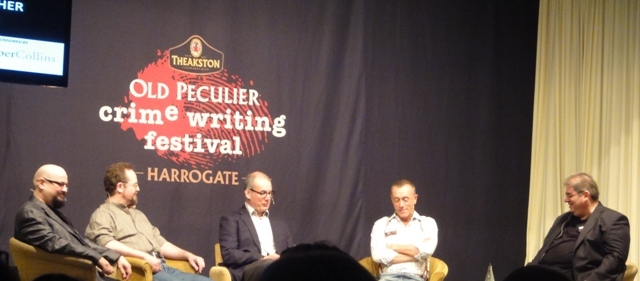
My next panel was on Saturday morning about The (A?) Golden Age.

From the programme:

For many, the Golden Age of British crime fiction was the 1920s and 1930s, when writers such as Christie, Allingham, and Sayers were at their peaks. Others would argue that we are currently living through crime fiction’s true Golden Age and that contemporary writers are more than a match for the Golden Oldies. Banging the drum for the here and now are Stuart Neville and Robert Wilson, while Nicola Upson and David Roberts will be talking up the cosies. Chairman, Martyn Waites (aka Tania Carver) will do his best not to take sides.


My notes:
The Golden Age dead or is it now? Was it the Golden Age and what made it so?

NU crucial age of crime fiction was between wars as lots of writers working with set conventions. TGA established a genre of crime fiction with set rules that can then be broken.

DR hates that word cosy - demeaning and patronising. TGA started 1920 and died out in 1950s; there were some superb novelists eg Dorothy L Sayers, who despised own books; Agatha Christie was a good writer, Tey, Nicholas Blake - that's what makes it GA - very good writers and better than a lot today (ooh! -  controversy)

RW said after WW1, needing to set the world to rights. He reminded self of GA by reading Strong Poison (DLS); ruling classes wiped out the working class by bad decisions, but business as usual in novels. DR disagreed - upper classes suffered great losses too, first over the top life expectancy of two weeks for young officers. Rules about good and evil, which are not so clear in modern novels as "evil" is explained by social reasons. RW said that by the end of WW2 knew what is evil is : Hitler.

NU: direct correlation between WW! and GA but not due to class. Books show the importance of an individual life -  one life can matter against mass slaughter of war.

SN asks who's reading GA?

MW:  Christie villains often a foreigner or a member of working class. But DR said don't forget Poirot ia foreign refugee and that Miss Marple is part of a despised generation and a spinster. Upper classes can ask questions and and travel so as not restricted to a couple of villages like Midsommer Murders - so convenient  to have aristocratic sleuth, not just snobbery.

Character of today's crime fiction.

SN said not *the* GA,  several GAs eg Chandler, Hammet, Irish (though not sure that's true), Scandinavian.
 
SN writes about a sympathetic mass murderer. Sophisticated readership needed?

DR said there was too much violence in RWs books. The constant use of violence is like a drug, keeps needing to be increased.

MW said have moral responsibility to put violence in book as dealing with a violent death.

NU:  Tey made a distinction between legal and moral justice.

DR:  Harret Vane (in DLS) almost died,  not because of murder but because of not being married to the person she was living with.

MW: when read GA didn't recognise the England in it as he grew up in Newcastle.

Is it yearning for an England that didn't exist?

SN - all crime fiction is escapism. Amplified compared to real life and you get justice - also rare in real life.
RW - Scandinavian crime fiction popular as seen as ideal countries, now no-one want to go there!

MW - original titles of TGWTDT - Men who Hate Women - could be a title for any noir novel.

NU - Not all GA set in village eg Tiger in the Smoke by Allingham is set in London. Read Tey to see what it's like for women between the wars.

DR - why would you reread once you know the killer but AC still read in France, USA. How many books written today would people go back to? No cohesive school.

SN - there are movements rather than individual novels: tartan noir, Irish, Scandinavian.

GA definition excludes writers such as Patrick Hamilton.

Books read from that period do seem to be crime fiction rather than best sellers/classics (eg Huxley)

MW - nice if bit sooner didn't have to wait 50 years to be feted.

RW is term cosy patronising? Yes says DR.

AC is fondly remembered as bridge gap between child and adult reading.

MW suggests that cosy has mutated into forensic novel? eg Patricia Cornwell doesn't look at psychology behind it, less cake and more blood.

NU: best novels put character forefront.

DR would put P D James into GA. He hates violence and serial killers in modern stuff. Detective who is alcoholic, chip on shoulder and close family is investigated and they go and investigate - "word for it, self-indulgent comes to mind".

MW mentions Knox's The Decalogue, the ten rules for crime fiction reads out many of them eg must not include a Chinaman.

SN love writing from villain(s) pov, if couldn't write from that then couldn't write at all.

DR asks do you identify with killer? SN says evil doesn't know its own reflection. In their mind are doing the right thing. NU loves to write murder's pov as well. People like you and me not evil. Doesn't see self as writing GA novels as writing with modern sensibility re sex, violence set in the past. MW every one is a hero in their own story.

DR greatest proponent of this is Patricia Highsmith with Ripley - a modern GA writer, little violence but MW disagrees. There is violence but not modern torture.

RW re Thomas Harris - M Mann version of Lecter was evil, Anthony Hopkins version is a vaudeville character but more popular.

What have we gained/lost from GA?

SN it established a framework. Variety crime fiction can take. (leading onto phrase) transcends the genre - MW "twatish phrase that is!"

NU books we can enjoy, in bucket-loads. People return to Tey

DR more than just taking a sweetie - put aside Henry James and pick up Aggie with a guilty sigh.

Question from the audience:
Why do people keep creating defective humans?

MW - people like to read about damaged people and so feel better about self.

SN - deals with phsical rather than emotional damage in new book.

MW - happy is hard to write about. SN - Brian McGilloway does it well

DR - write about decent people not necessarily happy

NU  - most damaged person she's written about- Alfred Hitchcock. Day to day morality for Tey and DLS - they didn't always write abut murder

SH - defective detective - can work if genius eg Sherlock Holmes.

DR - loves P James books but wishes Grace would "only find his bloody wife" and then he could relax.

MW: any good novel should make you laugh/cry/think.

First GA was female, English writers and second one influenced by Americans.

Chandler and Wodehouse in same class at Dulwich. Imagine Marlowe & Wooster together!

Sunday, July 22, 2012

Harrogate - America's Got Talent

This is the last panel I went to on Friday, America's Got Talent. I've almost finished reading Gillian Flynn's compulsive Gone Girl and I have one of Megan Abbott's books in my tbr. And with John Connolly moderating you know you're in for a well-researched and witty time! This was a very good panel and spurred many a purchase.

From the programme:

We are thrilled to showcase four of the most acclaimed new crime writers in America. Ryan David Jahn’s Acts Of Violence won the New Blood Dagger while Sharp Objects by Gillian Flynn picked up not only the New Blood award but also the Ian Fleming Steel Dagger. Chris Mooney has received rave reviews from the likes of Michael Connelly and Dennis Lehane and Megan Abbott’s hugely praised The End Of Everything was a Richard and Judy Book Club pick. These four will be talking to one of this year’s special guests, John Connolly.


My notes:
JC opens by saying that his panelists are "linked by a common inability to pronounce aluminium. It's alu-min-ium."

It's soon apparent that Chris Mooney is the fall-guy for JC's jokes. JC makes several references to CM's Remembering Sarah which was Edgar-award nominated.

GF's first book Sharp Objects was described as having a moist tone and JC wanted to know what that was exactly! GF described it as a lush, sensual, Gothic tone.

(Incidentally Gillian is pronounced with hard G.) She writes for Entertainment Weekly Magazine, full of pop culture and writing gives her the opportunity to be the opposite so you won't find any pop culture references in Sharp Objects. Gone Girl is borderline crime fiction and very different to her first two books; she wanted to write about relationships and marriage, and then had to construct a mystery around it. Bleak look at married life.

In MA's Dare Me - the crime is almost incidental, not jacketed here as crime novel. MA was editor of school paper; cheerleaders remind her of soldiers, very athletic training nowadays.

CM moved Malcolm Fletcher from peripheral character n an earlier book to main character in new series.

His Darby books came easier, writing about women, wants to understand women.

Question from JC about the practice of putting people's ashes into strange things ("you Americans") and there is a company in the US putting ashes into bullets.

RDJ - screenwriter before but didn't like producers much, as they made changes based on structure rather than story based. He worked in reality tv and was fired. The Getaway/Thompson influence on The Dispatcher. Fascinated by violence as experienced in the moment not war as a subject.(He was in army)

MA is a movie lover, and gangster movies were always on when growing up.

GF's dad is a film professor so she saw Alien at age 7!

MA said that in the US, they are very influenced by the idea of lone man, outlaw and 50-75% are about a PI or a cop who is against the system.

(JC did ask which British writers they read: Mark Billingham's name came up but the panel didn't give the impression of reading many British authors.)

JC said he didn't moderate many panels as it was too much like homework but he thoroughly recommended these four authors.

Saturday, July 21, 2012

Harrogate - Writing for Your Life

I missed the controversial e-book panel to get some sustenance and returned for:

Writing for Your Life:

Writers are often told to ‘write what you know’, but what if that knowledge could cost you your life? This is a unique opportunity to hear former intelligence agents and investigative journalists talk about revealing the secrets that some people want kept hidden. From the safety of their cosy offices, most crime writers routinely knock off tales of murder, but David Hosp, Chris Morgan Jones, Tony Thompson and Boris Starling tell Charles Cumming what it’s like when the writing itself is a matter of life and death?


My rather brief notes:

CC applied to work at MI6 but contrary to rumour didn't get in. Thinly disguised Vladimir Putin in The Trinity Six.

CMJ: described as a "loss" when lose a target that's under surveillance. Cannot track someone with just one person unlike in films/books.

BS also writing as Daniel Blake with a series set in the US: New Orleans, Pittsburg.

DH writes on ferry to Boston and back cf le Carre on a train

TT is a true crime writer - has he risked his life - yes and told of when he interviewed a criminal called The Governor; he only wanted a short quote and so took no notes. The Governor rambled on for an hour and then wanted TT to read his words back to him. TT had a few minutes to decipher (his non-existent) shorthand notes and then had to read it three times (in front of burly thugs) before being allowed free.
DH (a lawyer) is involved in the Innocence Project - looking at cases where the person might be innocent. His third book, Innocence is based on the project - a real case where fingerprint faked and whole dept shut down for 3 years,

CMJ would get others people to take risks, didn't do surveillance himself and recommends that you always have a woman on the team as they are less obtrusive.

DH's new book, The Guardian, is a standalone looking at the changing role of women in military, though they can't go into combat there are a lot in military police. he's toying with the idea of bringing her back.

Harrogate - Drawing the Line

My third panel and this time I took notes by hand. Drawing the Line featured Tim Weaver, Margie Orford, Penny Hancock, Gregg Hurwitz and N J Cooper moderating.

Panel blurb: When it comes to making moral choices, how far should a writer go? Do they worry about titillating those who may be tempted to emulate the terrible crimes they read about? And do writers ever fear for their own psyches when coming up with ideas which push the envelope of acceptability?


My notes:
NC commented that kidnap featured in novels by all 4 of them.

MO said that South Africa is much more dangerous than England, children, people do disappear. [I'm not sure if she was joking] said that she had morgue on speed dial as she has 3 daughters. South Africa is rape capital of the world. It's more fun to write emotional torture than physical.

GH said that he would sometimes leave an important bit out of a description eg if he was describing making a bomb.

MO came to write crime to try and understand why there is so much violence in South Africa.

PH wanted to explore the psychology of a woman (who'd kidnap a teenage boy) - wouldn't be interested in the scenario if the genders were reversed. Hasn't found any examples of a female kidnapping a boy.

TW said that 25% readers found his first book too violent and said he was hurt by that as it it implied that he had no control over his writing. There was going to be a scene with dog cruelty but he was advised (and did) to take it out.

MO was going to have the cat killed off - as didn't fit her character's life but she received an email from a fan saying whatever you do don't harm the cat. The cat was reprieved and she has to re-edit book and put cat care routines in!

MO - fear of fear, moved back to South Africa in 2001 with her 3 daughters and was scared but the mortuary on a Monday morning would show bodies of young men, not women. Said that dead women are often passed to women pathologists as men get too upset. Superstition that if you write about something you are warding it off.

Both GH and MO are reported to be more pleasant when working on a book.


There is a poison line you can ring in US and GH rang to ask about the poisonous nature of oleander and there was a pause and the recipient of the call asked "Sir, may I ask what number you're calling from"!

MO wrote journalist pieces but needed more space to explore true crime. Cops - fluke if they catch someone - only chiefs of police going to jail at the moment. Most people in South Africa experience violence themselves or a close family/friend has.

Harrogate - Crime in Another Dimension

The second panel of the day at Harrogate was Crime in Another Dimension. Talking cross-over novels were Ben Aaronovitch, (Euro Crime favourite) Christopher Fowler, Stuart MacBride and Charles Stross, moderated by David Quantick.

This was a chatty and funny panel with a running joke about changing your name by adding a letter or calling yourself  S J.


Here are my notes:
BA writes cross-overs due to laziness as he couldn't decide what genre to write so put it all in one novel. He's not sure if it is easier, but you have to write what you enjoy writing. Writers' ego believes that people will want to read what you've written.

CF start where you are most interested, Bryant & May contain supernatural but against the mythic background that is London. 2000 years of history. Asked why B & M not aging properly - because they're like the Simpsons, it's fiction! Addresses issue in new book (Bryant and May and the Invisible Code) though Bryant avoids answering.

BA made his hero 25 deliberately to avoid the Rankin problem (retirement age).

SM calls Halfhead a near future thriller not SF. He wrote it before the Logan books and would like to do something different but publishers not keen.

CS Rule 34 , set 15 years ahead. 90% of near future is here today. 9% is new stuff 1% unimaginable. As part of research he discovered that anything you can imagine - there's pornography about it.

David Tennant  was to narrate Cold Granite but got cast as Dr Who so didn't. (Some discussion about Michael Moorcock's Dr Who book - The Coming of the Terraphiles - apparently he didn't want to do it but they kept throwing money at him) SM available for Dr Who book project as loves Dr Who.

BA - book was originally a tv project, cliches bolted together, originally level entry role for a Jamaican woman but then wrote the name Peter Brant and background developed. You can pay police for info (300 pounds) and speak to a currently serving officer rather than a retired one.

CF - a bitter WPC sent him her notebooks, which seem to be in code with all the police acronyms!

CS - suggests looking for blogs of serving cops.

( I think BA said this) Wallander has no reason to be depressed, 1 murder every few years he should just be pleased when there's a murder!

Audience question:

Which book of their would the authors recommended you try

CS: The Atrocity Archives
SM: Currently unpublished novella, Ring of Githa (from sound of it won't get pubbed!)
CF: Kalabash
BA: Rivers of London

Friday, July 20, 2012

Harrogate - John Connolly interview

So, I'm currently away at the Harrogate Crime Writing Festival. There are loads of people some 12000 tickets have been sold.

The events are in the ballroom at the Old Swan Hotel. Unfortunately for those of us taking notes, the lights are dimmed and there aren't any power sockets. Hence my notes are written in the dark!

Here are my notes from the first session, Mark Billingham interviewing John Connolly:

It took JC about 5 years to write Every Dead Thing (he admits to not being a very good journalist)

He was awarded a huge advance for EDT but at the time had an empty bank account and needed an overdraft to buy a car. When he came to borrow money, bank knew who he was and didn't ask him to sign any papers (one rule for one and one for little people; he was no longer little people)

Being a freelance journalist meant you are responsible for your own destiny.  As a writer you live in perpetual fear of being dropped despite him having published 11+ books. Reality is that you can be dropped you only have 2 book cushion. Writing a series limits experimentation. With most writers' standalones you could drop main character in; there's no real broadening of range. Readers may not follow you to you new book as follow characters; very few parts of literature where you can dip into lives of characters from book to book.

JC a late bloomer reading crime fiction. James Lee Burke - arguably the greatest living crime writer in terms of language and landscape ("you can argue but you'd be wrong") and Ross MacDonald (being republished by Penguin) whose empathetic character is like a christ figure taking on everyone's sins.

No tradition in Irish crime writing and he didn't want to start one. Grim in 1970s, didn't want to write about famine, Irish writers didn't engage with England, wouldn't model themselves on English writers. Difficult to write crime fiction whilst mired in the Troubles, all criminality linked to IRA so couldn't write about crime without writing about Troubles.

Benjamin Black couldn't couldn't have written Christine Falls at the time it was (1950s) set as it was about Magdalen Laundries.

Irish authors get a better response in US and sell better.

He didn't expect to be published, rejected by everyone except current publisher and agent. Given wise advice to finish writing for own reasons ie if left unfinished he may not have written anything else.

Doubt is what makes it good if you think 20k words in its rubbish then probably worth reading in the end.

It wasn't until the third book that he thought he was going to be writing for a while and the books change and become a sequence of novels (The Unquiet almost a standalone). Writer's first book is an index of what writer is going to write about in his career.  Each book is an experiment, different pacing and tone. Very little violence in The Burning Soul and more dialogue.

He has to find something for Louis and Angel (two popular characters) to do without it seeming gratuitous - they change the tone - add humour and humanises Parker - so you can see why people like him. Also to help reader through book, and a reward for long descriptive passages.

MB said books described as supernatural thriller or detective gothic (or shit says JC)

JC read horror as teenager - good way for teenagers to engage with adult world, why Twilight so popular. Adults shouldn't be reading it. Just stop and read some Dickens.

When he first came to Britain - he saw how conservative British crime fiction establishment was.

Going on to talk about Noctures (a collection of ghost stories): radio very big in Ireland so when asked if he wanted to write for tv said would do ghost stories for radio -  supposed to be for late at night but first series went out at 4pm!

The 'good daughter' short story in Nocturnes made into film with Kevin Costner. JC is very protective of books but filming a short story is expansion rather than compression. It's a fairy tale but it was moved to South Carolina which has no tradition of fairy tales. He says film is not bad but a bit slow.

The Book of Lost Things made MB cry slightly - partly autobiographical

One of his villains is back in The Wrath of Angels.

People aren't evil but are selfish

The Inkpot Monkey was the first short story he wrote.

Charlie Parker has JC's sense of humour but also glass is half empty/introspection.

The favourite death scene is written is for a man who was using a mobile hone in a cafe and was beaten and then shot - based closely on an incident JC had experienced (ie the phone, not the killing!). It's in Bad Men and the victim is given a lecture on phone etiquette.

JC and Declan Burke have just edited Books to Die For (out August) - 120 crime writers from around the world asked about the single book they'd force on a reader; one of the best essay's is MB's on The Maltese Falcon.

Thursday, July 19, 2012

Winner of Theakstons Crime Novel of the Year Award 2012

The winner of the Theakstons Old Peculier Crime Novel of the Year Award 2012 was announced tonight at the opening ceremony for the tenth Harrogate Crime Writing Festival.

And the winner is...Denise Mina for The End of the Wasp Season

Also Shortlisted (links are to Euro Crime reviews)

Now You See Me by SJ Bolton (Corgi)
Where the Bodies Are Buried by Chris Brookmyre (Abacus)
The Burning Soul by John Connolly (Hodder Paperback)
Black Flowers by Steve Mosby (Orion)
Before I Go To Sleep by SJ Watson (Black Swan)

Photos of (some of) the nominees receiving their tankards:

SJ Bolton

John Connolly

Denise Mina
Steve Mosby
SJ Watson

Colin Dexter speaking after receiving the Theakstons Old Peculier Outstanding Contribution to Crime Fiction Award:


and the winner of the crime novel of the year is...Denise Mina (with Simon Theakston)


New Titles from Hodder & Stoughton

Browsing through the new Hodder & Stoughton catalogue for July-December 2012, these are the titles of "euro crime"  interest:

Non-fiction

Books to Die For edited by John Connolly & Declan Burke (August)

Fiction


July

Jasper Fforde - The Woman Who Died a Lot (#7 Thursday Next)

Ali Knight - The First Cut

Stephen Leather - False Friends (#9 Dan Shepherd, SAS trooper turned undercover cop)

Catriona McPherson - Dandy Gilver and a Bothersome Number of Corpses (#7 Dandy Gilver, Society Sleuth, 1920s Scotland)

Gerald Seymour - The Outsiders

Marco Vichi - Death in Sardinia (#3 Inspector Bordelli, Florence, 1960s)


August

John Connolly - The Wrath of Angels (#11 Charlie Parker, PI, Maine)

Simon Conway - Rock Creek Park


September

Julie Corbin _ Do Me No Harm (paperback)

Deon Meyer - 7 Days (Benny Griessel)

Peter Robinson - Watching the Dark (#20 Insp. Alan Banks, Yorkshire)

Chris Ryan - Osama


October

Yrsa Sigurdardottir - I Remember You (NB. Ghost story not crime)


November

Derek Haas - The Right Hand

Roger Pearce - Agent of the State (paperback)

Wednesday, July 18, 2012

Review: In the Darkness by Karin Fossum

In the Darkness by Karin Fossum translated by James Anderson, July 2012, 320 pages, Harvill Secker, ISBN: 1846555256

Published in 1995 in its original Norwegian, IN THE DARKNESS, the first Inspector Sejer novel has finally made into English. Despite its relative age the story doesn't feel that dated except for the obvious lack of mobile phones. Fossum's stories have a timeless quality about them dealing as they do with human nature which doesn't seem to change.

The first chapter has an unknown, bedraggled and injured woman coming into the police station with Sejer. The story then jumps back a week or so and we meet Eva and her daughter Emma who, when walking by the canal discover a dead man floating in it. Eva's behaviour is odd. She goes into a phone-box but rather than call the police she rings her dad but pretends to Emma she has called the authorities and that they don't need to wait.

Sejer and his small team, including Skarre (who is his sidekick in the later books), begin an investigation into the dead man who is soon identified as Egil a missing man from four months ago, a brewery worker who had gone out to sell his car to a mysterious buyer. Sejer also has the unsolved murder of Maja a prostitute who lived close to where Egil socialised at night and died a few days before he went missing. Are these two deaths connected?

Eva was Maja's best friend and was questioned at the time of her friend's death and now finds herself being requestioned by the implacable Sejer. Eva is in a terrible mental state as someone is after her and when that someone catches up with her she finally gets to tell of the events that have gone on in the last four months.

As the first book in the series, Konrad Sejer is introduced in more detail than he is in the later books: his physical description, his clothes, his family situation, his dog and he even does some skydiving (which is mentioned in one of the later books). However he isn't in it as much as you'd think from the opening chapters. He has a team (and a boss) rather than it being him and Skarre however much of the book belongs to Eva. The original title is Eva's Eye and it's her story we hear, though Sejer appears regularly in it.

The moral behind IN THE DARKNESS could be that “money is the root of all evil” as it is money that drives the actions of those who are killed and it's money that makes Eva's life so complicated. It also shows how a once law-biding person can be tempted to do illegal acts with reasonable justification. This is a well-plotted novel with plenty of surprises. It's also a melancholy tale as many people's lives are ruined or lost.

Interestingly it also contains the seeds for the next book, as the team are notified about the disappearance of the six-year-old girl Ragnhild, which opens the Glass Key award-winning DON'T LOOK BACK.

Tuesday, July 17, 2012

OT: Queen's English?

I've been over in North Norfolk for a few days and as usual we went to the shop at Sandringham. I spotted these items - not quite the Queen's English!


Thursday, July 12, 2012

International Dagger Speculation (2013)

Now 2012's prize for the CWA International Dagger has been awarded we can turn our attention to the next crop of titles, eligible for 2013's crown.

So here's the list so far of translated crime novels published between June 2012 and May 2013 ie the period of eligibility. There's 75* so far (cf 77 last year). NB. Only 1 book per author can be submitted for consideration.

For ease of purchase/library reservation here they are listed by UK month of publication:

In addition to the list I have set up a Good Reads widget on the right-hand side of the blog. This allows the covers to be visible plus you can add them to your wish-list on Good Reads. I won't be filling in the rating system though! Should you wish to, you can subscribe to this list through RSS at: http://www.goodreads.com/review/list_rss/5685010?key=1b15df702ba77995285c11ceb3a3c30a124dd934&shelf=int-dagger-eligible-2013. I've added as many as I can find though I have used the original covers if the English one isn't on Good Reads yet.

I've also included the country of birth and gender of the author(s):

*this total includes titles published by Amazon Crossing, which I have flagged. I am not sure if these count as UK publications however I imagine people interested in this list will also be interested in these books.

June

Jussi Adler-Olsen - Disgrace tr. K E Semmel (apa The Absent One) (Denmark, M)
Patrick Conrad - No Sale tr. Jonathan Lynn (Belgium, M)
Kjell Eriksson - The Cruel Stars of the Night tr. Ebba Segerberg (Sweden, M) (First UK Publication)
Giorgio Faletti - The Killer in My Eyes tr. Howard Curtis (Italy, M)
Pascal Garnier - How's the Pain? tr. Emily Boyce (France, M)
Wolf Haas - Brenner and God tr. Annie Janusch (Austria, M)
Arnaldur Indridason - Black Skies tr. Victoria Cribb (Iceland, M)
Pia Juul - The Murder of Halland tr. Martin Aitken (Denmark, F)
Asa Larsson - The Black Path tr. Marlaine Delargy (Sweden, F) (First UK Publication)
Antonin Varenne - Bed of Nails tr. Sian Reynolds (France, M)
Jan Wallentin - Strindberg's Star (Sweden, M)
Carlos Ruiz Zafon - The Prisoner of Heaven (Spain, M)

July

Donato Carrisi - The Lost Girls of Rome tr. Howard Curtis (Italy, M)
Arne Dahl - Misterioso (apa The Blinded Man) tr. Tiina Nunnally (Sweden, M)
Thomas Enger - Pierced tr. Charlotte Barslund (Norway, M)
Karin Fossum - In the Darkness, tr. James Anderson (Norway, F)
Santiago Gamboa - Necropolis (Colombia, M)
Thomas Glavinic - The Camera Killer (Austria, M)
Grebe & Traff - Some Kind of Peace (Sweden, F & F)
F G Haghenbeck - Bitter Drink (Mexico, M) (Amazon Crossing)
Hjorth-Rosenfeldt - Sebastian Bergman (Sweden, M & M)
Anne Holt - Blind Goddess, tr. Tom Geddes (Norway, F)
Mehmet Murat Somer - The Wig Murders (Turkey, M) (moved to 2014)
Stefan Tegenfalk - Project Nirvana (Sweden, M) (available in ebook only at the moment so not yet eligible)
Marco Vichi - Death in Sardinia tr. Stephen Sartarelli (Italy, M)

August

Fabrice Bourland - The Dream Killer of Paris tr. Morag Young (France, M)
Sebastian Fitzek - The Eye Collector (Germany, M)
Marek Krajewski - The Minotaur's Head tr. Danusia Stok (Poland, M)
Deon Meyer - Seven Days tr. K L Seegers (South Africa, M)
Fuminori Nakamura - The Thief tr. Satoko Izumo & Stephen Coates (Japan, M)
Kristina Ohlsson - Silenced tr. Sarah Death (Sweden, F)
Giorgio Scerbanenco - A Private Venus (Ukraine/Italy, M)
Arni Thorarinsson - Season of the Witch tr. Anna Yates (Iceland, M) (Amazon Crossing)

September

Camilla Ceder - Babylon tr Marlaine Delargy (Sweden, F)
Mons Kallentoft - Autumn Killing tr. Neil Smith (Sweden, M)
Lars Kepler - The Nightmare tr. Laura A Wideburg (Sweden, M & F)
Liza Marklund - Last Will tr. Neil Smith (Sweden, F)
Zygmunt Miloszewski - A Grain of Truth (Poland, M)
Ferdinand von Schirach - The Collini Case tr. Anthea Bell (Germany, M)

October

Jo Nesbo - The Bat tr. Don Bartlett (Norway, M)

November

Andrea Camilleri - The Age of Doubt tr. Stephen Sartarelli (Italy, M)
Kaaberbol & Friis - Invisible Murders (Denmark, F & F)
Luis Fernando Verissimo - The Spies (Brazil, M)

December

Sandrone Dazieri - In a Heartbeat (Italy, M)
Leena Lehtolainen - My First Murder tr. Owen Witesman (Finland, F) (Amazon Crossing)
Noboru Tsujihara - Jasmine (Japan, M)

January

Pascal Garnier - The A26 (France, M)
Shuichi Yoshida - Parade (Japan, M) (moved to August 2013)

February


Keigo Higashino - Salvation of a Saint tr. Alexander O Smith with Elye J Alexander (Japan, M)
Pierre Lemaitre - Alex tr. Frank Wynne (France, M)
Leif GW Persson - Linda, As in the Linda Murder, tr. Neil Smith (Sweden, M) 
Teresa Solana - The Sound of One Hand Killing tr. Peter Bush (Spain, F)
Antti Tuomainen - The Healer tr. Lola Rogers (Finland, M)
Marco Vichi - Death in Florence (Italy, M) (moved to July 2013)

March

Esmahan Aykol - Baksheesh tr. Ruth Whitehouse (Turkish, F)
Andrea Camilleri - The Dance of the Seagull tr. Stephen Sartarelli (Italy, M)
Roberto Costantini - The Deliverance of Evil tr. N S Thompson (Italy, M)
Marie Hermanson - The Devil's Sanctuary (Sweden, F)
Fabrice Humbert - Sila's Fortune (France, M)
Anne Holt - Blessed Are Those Who Thirst (Norway, F)
Mari Jungstedt - The Double Silence (Sweden, F) (moved to July 2013)
Camilla Lackberg - The Lost Boy (Sweden, F)
Alexander Söderberg - The Andalucian Friend tr. Neil Smith (Sweden, M)
Johan Theorin - The Asylum tr. Marlaine Delargy (Sweden, M) 
Fred Vargas - The Ghost Riders of Ordebec tr. Sian Reynolds (France, F)

April

Jussi Adler-Olsen - Redemption tr. Martin Aitken (Denmark, M) (moved to July 2013)
Mariusz Czubaj - 21:37 tr. Anna Hyde (Poland, M)
Gaute Heivoll - Before I Burn tr. Don Bartlett (Norway, M)
Mons Kallentoft - Savage Spring tr. Neil Smith (Sweden, M)
Liza Marklund - Lifetime tr. Neil Smith (Sweden, F) 
D A Mishani - The Missing File (Israel, M)
Hakan Nesser - The Weeping Girl tr. Laurie Thompson (Sweden, M)
Roslund & Hellstrom - Two Soldiers tr. Kari Dickson (Sweden, M & M)

May

Massimo Carlotto - At the End of a Dull Day tr. Antony Shugaar (Italy, M)
Maurizio de Giovanni - Blood Curse tr. Antony Shugaar (Italy, M)
Antonio Hill - The Good Suicides (Spain, M) (moved to June 2013)
Natsuo Kirino - In (Japan, F) (moved to June 2013)
Jens Lapidus - Never Screw Up (Sweden, M) (moved to November 2013)
Leena Lehtolainen - Her Enemy (Finland, F) (Amazon Crossing)
Guillaume Musso - The Angel's Call (France, M)
Leif GW Persson - He Who Kills the Dragon (Sweden, M) (moved to Oct. 2013)
Yrsa Sigurdardottir - Someone to Watch Over Me (Iceland, F)
Edney Silvestre - If I Close My Eyes Now (Brazil, M)
Carlos Ruiz Zafon - The Watcher in the Shadows (Spain M)

Wednesday, July 11, 2012

Mini Review: If I'm Dead by Marcia Clark

Slightly OT this one as it's an American author writing about an American setting.

Marcia Clark's If I'm Dead is a short story available on Kindle or as Epub (99p at the moment, though free when I "bought" it).

It's set between her two full-length novels, Guilt by Association and Guilt by Degrees which I haven't yet read and as well as the short story you also get samples from these two books.

The problem with the Kindle version, with its % read is that I can't tell you the number of page numbers, however it is quite short.

Series character Rachel Knight, Deputy District Attorney in Los Angeles is prosecuting a tricky case. A rich heiress is presumed dead, killed by her husband whom she wanted to divorce. With no body and mostly circumstantial evidence can Rachel put away the presumed killer?

As Rachel is assigned to the Special Trials Unit she works with the police from the moment the crime is discovered which means that If I'm Dead is a mix of investigation and courtroom drama. You get to meet Rachel and her some of friends/colleagues, all female though called Bailey, Dorian and Toni and there is a cracker of an abrupt ending. I enjoyed it and it's done the trick of making me want to read the full-length books.

I've always been a fan of legal tv dramas such as Ally McBeal, Justice and Shark and this would have made a great episode for the latter two (though on opposing sides!).

Maxine at Petrona has reviewed Guilt by Association.

Cited on Ashes by Sergios Gakas

I am very fond of Ashes by Sergios Gakas so I was very chuffed to see a quote from my review on the reverse of the paperback edition which came out on 5 July.

My review in full.

I've been keeping a record of quotes from Euro Crime used on books, though it's not comprehensive, here.


Tuesday, July 10, 2012

DVD News: Once Upon a Time in Anatolia

I mentioned this film Once Upon a Time in Anatolia earlier in the year when it had a limited release. Like so many subtitled films (Headhunters, Silence) I wasn't able to see it at the cinema however it has just been released on DVD and it's on my library's catalogue so I've reserved it. As it's classed as "World Cinema" it bypasses the top-title two-day loan category (non-reservable to boot) and goes straight to 7 day loan (£1.50). This is particularly useful for Once Upon a Time in Anatolia which is nearly three hours long so will be watched over several evenings!


An epic and rigorous tale of a night and day in a murder investigation, Once Upon a Time in Anatolia is a beautifully photographed crime drama about police and prosecutors locating a buried body through one long night in the Anatolian steppes.

In the short prologue three men are drinking and talking. Then a convoy of cars is travelling around the countryside at night as one of the men seen earlier is trying to remember where a body was buried. After several false leads and a rest in a remote village, the body is finally discovered early the next morning. In the course of the long investigation the characters and hidden thoughts of the main protagonists are gradually themselves exhumed.

Mini Review: The Holy Thief by William Ryan (audio book)

I've just had the pleasure of listening to an ISIS audio book of William Ryan's The Holy Thief read by Sean Barrett.

Sean Barrett is excellent as I knew he would be as I've listened to him read Henning Mankell's booksl. (He's also got the Jo Nesbo gig.)

I really enjoyed The Holy Thief and felt I learned a lot about Russia in the 1930s. Be aware that there are a couple of torture scenes and unpleasant descriptions of the aftermath, in this fine police procedural which introduces Captain Korolev of the CID of the Moscow Militia. he is a good man, struggling with loyalty to the state and his own religious beliefs.

For a full assessment please read Rich's excellent review, with which I agree completely, here.

The Holy Thief was shortlisted for the Theakstons Crime Novel of the Year 2011 and the CWA New Blood (John Creasey) Dagger 2010


The second in the series, The Bloody Meadow, is available now and a third book should be out in 2013.

William Ryan's website
William Ryan on Twitter

Monday, July 09, 2012

The Return of Case Sensitive

The ITV series based on Sophie Hannah's books returns to ITV on Thursday at 9pm with a two-part adaptation of the fourth book in the series, The Other Half Lives reviewed for Euro Crime by Maxine and Michelle.

The second part is on Friday at 9pm.

From the ITV website:
Case Sensitive returns for a second series, based on Sophie Hannah's best selling novel The Other Half Lives.

Alarm bells ring when DS Charlie Zailer (Olivia Williams) is asked to check a friend's new partner for a criminal record.

Joined once more by DC Simon Waterhouse (Darren Boyd), what follows is an investigation littered with thwarted dreams and murderous jealousy, as Zailer's suspicions force her to take erratic steps to keep the case on track and her friend safe from harm.


Salvation of a Saint - Cover Opinions

I haven't been doing the "cover opinions" posts for a while so I'm reinstating them, starting with a book that's not out until October (US) and February (UK).

It's one of the eligibles for the 2013 International Dagger: Salvation of a Saint by Keigo Higashino translated by Alexander O Smith.

The UK cover is similar to the UK trade paperback release of The Devotion of Suspect X, whereas (to me at least) the US cover looks like an American thriller. The US cover has gone with "Edgar Award Finalist" whereas the UK's has gone with "The Japanese Stieg Larsson"(!).

But what are your thoughts on the US (LHS) and UK (RHS) covers? Which would entice you to pick the book up?


Official blurb: When a man is discovered dead by poisoning in his empty home his beautiful wife, Ayane, immediately falls under suspicion. All clues point to Ayane being the logical suspect, but how could she have committed the crime when she was hundreds of miles away?


While Tokyo police detective Kusanagi tries to unpick a seemingly unrelated sequence of events he finds himself falling for Ayane. As his judgement becomes dangerously clouded his assistant must call on an old friend for help; it will take a genius to unravel the most spectacular web of deceit they have ever faced...


SALVATION OF A SAINT is a magnificently complex and page-turning thriller starring international crime fiction's most enigmatic sleuth.This is essential reading for all fans of exceptional crime fiction.

Sunday, July 08, 2012

New Reviews: Blake, Camilleri, Colfer, Judd, Lewis, Orsi, Quinn, Robertson, Tegenfalk

The range of reviews covers country-house, spy, police-procedural, historical, thriller and the settings include England, Germany, Burma, Argentina, Italy, Japan, Sweden and the USA.

Here are the new 9 reviews:
We continue our reviews of the reissue of four of Nicholas Blake's titles with Susan White reviewing Thou Shell of Death, a country-house mystery set at Christmas;

Rich Westwood reviews International Dagger winner Andrea Camilleri's The Track of Sand, tr. Stephen Sartarelli now out in paperback;

Lynn Harvey reviews Eoin Colfer's Plugged also out in paperback;

Terry Halligan reviews Alan Judd's Uncommon Enemy which has just been longlisted for the CWA's Steel Dagger;

Maxine Clarke reviews Simon Lewis's Border Run blurbed as "Lord of the Flies meets The Beach";

Amanda Gillies travels to Argentina for Holy City by Guillermo Orsi, tr. Nick Caistor calling it an "absolute belter";

Susan also reviews Susanna Quinn's Glass Geishas set in Japan;

Terry continues to be impressed by Imogen Robertson's historical series with the fourth, Circle of Shadows recently published

and I recently reviewed on the blog Stefan Tegenfalk's Anger Mode, tr. David Evans the first part in a Swedish trilogy.
Previous reviews can be found in the review archive.

Forthcoming titles can be found by author or date or by category, here along with releases by year.

Thursday, July 05, 2012

2012 CWA Dagger Winners and Longlists

 2012 CWA Dagger Winners and Longlists

As reported in the previous post, the International Dagger was won by Andrea Camilleri for The Potter's Field.

Several long-lists have also been announced tonight, links are to Euro Crime reviews:

The long list for the CWA John Creasey (New Blood) Dagger is as follows:

The Doll Princess by Tom Benn (Jonathan Cape)
Heart-Shaped Bruise by Tanya Byrne (Headline)
A Land More Kind than Home by Wiley Cash (Transworld/Bantam)
So Much Pretty by Cara Hoffman (Century)
Good People by Ewart Hutton (HarperCollins)
Turn of Mind by Alice LaPlante (Harvill Secker)
The Expats by Chris Pavone (Faber & Faber)
What Dies in Summer by Tom Wright (Canongate)

The long list for the CWA Ian Fleming Steel Dagger is as follows:

Dare Me by Megan Abbott (Picador)
The Shadow Patrol by Alex Berenson (Headline)
A Foreign Country by Charles Cumming (HarperCollins)
The Fear Index by Robert Harris (Hutchinson)
The Dispatcher by Ryan David Jahn (Macmillan)
Uncommon Enemy by Alan Judd (Simon & Schuster)
The Child Who by Simon Lelic (Mantle)
Reamde by Neal Stephenson (Atlantic Books)

The long list for the CWA Gold Dagger is as follows:

A Land More Kind than Home by Wiley Cash (Transworld/Bantam)
Vengeance in Mind by N.J. Cooper (Simon & Schuster)
Grandad, There’s a Head on the Beach by Colin Cotterill (Quercus)
The Flight by M.R. Hall (Mantle)
The Rage by Gene Kerrigan (Vintage)
Turn of Mind by Alice LaPlante (Harvill Secker)
The Child Who by Simon Lelic (Mantle)
Bereft by Chris Womersley (Quercus)
Plus the winners of the Historical and Library Daggers have been announced:
Ellis Peters Historical Dagger Shortlist

The Crown by Nancy Bilyeau (Orion)
I Will Have Vengeance by Maurizio de Giovanni (Hersilia Press)
Bitter Water by Gordon Ferris (Corvus)
Prague Fatale by Philip Kerr (Quercus)
Icelight by Aly Monroe (John Murray) - WINNER
Sacrilege by SJ Parris (HarperCollins)
A Willing Victim by Laura Wilson (Quercus)

Dagger in the Library Shortlist

Belinda Bauer
S.J. Bolton
Susan Hill
Peter May
Steve Mosby - WINNER
Imogen Robertson

More on all the selected books plus the Non-Fiction, Short Story and Debut Daggers can be found on the CWA's website.

The International Dagger 2012 goes to...

I'm very pleased to announce that the 2012 International Dagger goes to Andrea Camilleri for The Potter's Field. I absolutely loved this novel, superbly translated by Stephen Sartarelli.

(I am finally catching up on the Inspector Montalbano episodes shown earlier this year which are a real treat.)

The other 5 shortlisted titles were:
Maurizio De Giovanni - I Will Have Vengeance tr. Anne Milano Appel
Asa Larsson - Until Thy Wrath be Past tr. Laurie Thompson
Deon Meyer - Trackers tr. K L Seegers
Jo Nesbo - Phantom tr. Don Bartlett
Valerio Varesi - The Dark Valley tr. Joseph Farrell
More about the selected titles can be found at the CWA's website

Poll Results on International Dagger - 2012

The polls have now closed for voting on who you want to and think will win this year's CWA International Dagger. The Dagger winner will be announced this evening at the CWA Awards Ceremony in London.

There were 119 votes in the "want to win" and 80 votes in the "will win". In both cases the winner was Phantom by Jo Nesbo followed by The Potter's Field by Andrea Camilleri in the "want to win" and Trackers by Deon Meyer in the "will win".

I will remove the polls in the next couple of days. Many thanks to all those who took part and read the shortlist.

Which book do you want to win the International Dagger?


The Dark Valley got 3 votes (2%).

Which book will win the International Dagger?


I Will Have Vengeance received zero votes in this category.

Theakstons Crime Novel of the Year 2012 - Shortlist & Special Award for Colin Dexter

The shortlist for the Theakstons Old Peculier Crime Novel of the Year Award 2012 has been announced. The winner will be announced at Harrogate on 19 July, however we the public will be able to vote on the shortlist from today. Plus a special award for Colin Dexter has been announced.
2012 Shortlist (links are to Euro Crime reviews)

Now You See Me by SJ Bolton (Corgi)
Where the Bodies Are Buried by Chris Brookmyre (Abacus)
The Burning Soul by John Connolly (Hodder Paperback)
The End of the Wasp Season by Denise Mina (Orion)
Black Flowers by Steve Mosby (Orion)
Before I Go To Sleep by SJ Watson (Black Swan)

From the press release:

Chilling suspense thrillers lead the way on this year’s Theakstons Old Peculier Crime Novel of the Year Award shortlist. One of the most prestigious crime writing prizes in the country, the 2012 shortlist reflects the ever increasingly popularity of psychological and suspense-driven narratives.

In a move away from the grittier whodunits that have long dominated the crime fiction genre, this year’s shortlist is comprised of four thrillers out of six: SJ Watson’s smash hit debut Before I Go To Sleep; The Burning Soul by veteran author John Connolly; SJ Bolton’s multi-layered, page-turner Now You See Me; and Steve Mosby’s horror-tinged tale Black Flowers.

The two non-thriller titles are Where the Bodies Are Buried and The End of the Wasp Season by Chris Brookmyre and Denise Mina respectively, both of whom have based their plots on the streets of Glasgow and have focused on a police procedural style. The presence of two Scots on the list also reaffirms the consistent level of success enjoyed by crime writers north of the border.

Now in its eighth year, the Theakstons Old Peculier Crime Novel of the Year Award, in partnership with Asda - who will promote the shortlisted titles in stores nationwide from today - and in association with the Daily Mirror, was created to celebrate the very best in crime writing and is open to British and Irish authors whose novels were published in paperback from 1st June 2011 to 31st May 2012.

The overall winner will be decided by a public vote and a panel of experts which this year comprises DI Tom Thorne actor David Morrissey, Festival chair Mark Billingham, Daily Mirror Literary Editor and crime novelist Henry Sutton, Asda Fiction Buyer Ruth Lewis, and Simon Theakston, Executive Director of T&R Theakston Ltd.

The public vote opens today, Thursday 5th July, and closes on Tuesday 17th July at www.theakstons.co.uk

The winner of the prize will be announced by title sponsor Simon Theakston at an award ceremony hosted by radio broadcaster and Festival regular Mark Lawson on Thursday 19th July, the opening night of the 10th Theakstons Old Peculier Crime Writing Festival. The winner will receive a £3,000 cash prize as well as a handmade, engraved beer barrel provided by Theakstons brewery.

On the same night a special presentation will be made to the winner of the third Theakstons Old Peculier Outstanding Contribution to Crime Fiction Award, which this year is awarded to Colin Dexter, creator of Inspector Morse.

Born in Lincolnshire in 1930, Dexter won a scholarship to the local grammar school and, after completing his National Service, went on to study at Cambridge. Since 1966 he has lived in Oxford with his wife, with whom he has two children. After retiring from a 13-year teaching career, he began writing mysteries in 1973 while on a family holiday. His debut novel, Last Bus to Woodstock, was published in 1975 and introduced the world to Inspector Morse for the first time. One of the most iconic detectives ever to have been created, Morse’s crime-solving talents found a whole new audience in the successful TV series, bringing further acclaim for Dexter. Inspector Morse has appeared in 13 novels and numerous short stories. Dexter has won many awards for his novels, including the CWA Silver Dagger twice and the CWA Gold Dagger for both The Wench is Dead and The Way Through the Woods. In 1997, he was presented with the CWA Diamond Dagger for outstanding services to crime literature and, in 2000, was awarded the OBE in The Queen's Birthday Honours.

Dexter said: "Never had I thought that the gods would be kindly enough to give me such a huge honour so late in my life. Yet here I am, in my early eighties, feeling a profound and heartfelt gratitude for the great honour bestowed on me.”

Simon Theakston, Executive Director of T&R Theakston, said:
"The variety of narratives within crime fiction means that every year we have a shortlist that reflects the diversity of the genre; this year, the thriller seems to be the popular choice. It’s great to see crime writing in such rude health, although it doesn’t make the job of picking a winner any easier!

“I’m also delighted and privileged to welcome Colin Dexter to Harrogate to collect his much- deserved Outstanding Contribution to Crime Fiction Award. Few writers are as prolific as Colin has been over his long and varied career and even fewer create a character as iconic and well-loved as Morse. This award acknowledges Colin’s huge contribution to crime fiction and to British culture.”

Wednesday, July 04, 2012

Review: Anger Mode by Stefan Tegenfalk

Anger Mode by Stefan Tegenfalk translated by David Evans, August 2011, 430 pages, Nordic Noir Books, ISBN: 1908233001

Anger Mode is the first book in a trilogy from Swedish author Stefan Tegenfalk.

The book opens with a section from 2004 in which a horrible car accident kills two adults and a ten-year-old girl. The timeline then switches to and remains in 2009. A series of murders takes place in which the killer (a different person each time) in an inexplicable fit of anger murders someone close to them both physically and often emotionally. The killer then has no memory of the incident. These unusual cases reach the desk of experienced and maverick Stockholm County Detective Inspector Walter Grohn. Called in to assist him from a new special investigations unit, RSU, is Jonna de Brugge a young analyst who has been through the police academy.

They make some progress on the case but then several things happen. Walter is rushed into hospital and subsequently suspended from his job and the Swedish Security Service SAPO take over the case. SAPO's investigations take a different tack altogether and leads them to a group of so-called Muslim extremists.

The book then switches between SAPO investigator Martin Borg and his illegal attempts to show the world what the Muslims are up to (in his eyes) and Walter and Jonna and their attempts to find the common link between the deaths. Both narrative streams are linked (and eventually collide) by the actions and presence of amoral journalist Jorgen Blad who's been blackmailing a source in the police department.

Though the underlying whodunnit and why can be quite easily deduced by the police they are hamstrung by legality and have to resort to underhand methods to get the information they need to make the deduction. The inclusion of the SAPO storyline lengthens the book and I presume is necessary for the continuing bigger story, which is more than just a police investigation.

I enjoyed the book and in particular the parts involving Walter and Jonna who make a great team despite their differences. Jonna is a strong and intelligent character who stands up for herself and Walter is a loveable rogue who breaks all the rules, but is of course a damn fine cop and can play the political system when he needs to. There is humour to be found in Anger Mode particularly from Walter but also other characters. For example, this from the less than bright villain Tor:

"At first glance, the man did not seem to present much of a threat. Even so, Tor was on his guard when he bent over him to see how hard he had taken the blow. He had read the Lisbeth Salander novels and knew not to judge a book by his cover. If a thin anorexic could floor a blond giant, then this little fatso could take Tor, despite the fact that he was over two metres tall and had been a hardened criminal for thirty-five years."

In conclusion Anger Mode is very readable, though perhaps slightly too long and I personally could have lived without the SAPO storyline but I'll be able to judge that storyline better when I've read the remaining two books. The second part, Project Nirvana, is published 12 July 2012.

If you have a Kindle (UK) then snap this one up for 85p (at the moment).

Monday, July 02, 2012

Audiobooks are Forever...

Just look at the stellar readers assembled to read the James Bond novels for AudioGO. I'll be looking out for these in the library later this year.
From AudioGO's Facebook page:

Three years in the making, the project has seen distinguished director Enyd Williams and Lucy Fleming for Ian Fleming Publications, working closely with twelve British acting icons to create an exciting, modern ‘007 reloaded’ take on the new, unabridged recordings of these remarkable books.

Casino Royale read by Dan Stevens
Live and Let Die read by Rory Kinnear
Moonraker read by Bill Nighy
Diamonds Are Forever read by Damian Lewis
From Russia With Love read by Toby Stephens
Dr No read by Hugh Quarshie
Goldfinger read by Hugh Bonneville
Thunderball read by Jason Isaacs
The Spy Who Loved Me read by Rosamund Pike
On Her Majesty's Secret Service read by David Tennant
You Only Live Twice read by Martin Jarvis
The Man With the Golden Gun read by Kenneth Branagh

Each fantastic new Bond title will be available to pre-order on 1st August, and download or purchase on CD from 6th September

Sunday, July 01, 2012

New Reviews: Douglas, Fowler, Hall, Holt, Jackson, Kitson, Knight, Ridpath, Villar

The British writers are getting about this week with settings ranging from Germany, Iceland, India and the US as well as closer to home: London, Yorkshire and Scotland. Mainland Europe writers are featured with Norway and Spain.

NB. The International Dagger winner will be announced next week so you only have a couple of days left to vote in the International Dagger Polls.

Here are the new 9 reviews:
Amanda Gillies reviews James Douglas's The Doomsday Testament;

I review the audio book version of Christopher Fowler's, Bryant & May Off the Rails narrated splendidly as ever by Tim Goodman;

Susan White reviews Tarquin Hall's third Vish Puri outing, The Case of the Deadly Butter Chicken likening the author to P G Wodehouse;

Lynn Harvey reviews the paperback release of Anne Holt's Fear Not, tr. Marlaine Delargy the fourth (and best imho) in the Vik-Stubo series;

JF reviews David Jackson's second book set in New York, The Helper;

Terry Halligan reviews the sixth in Bill Kitson's Mike Nash series, Identity Crisis;

Terry also reviews Alanna Knight's The Seal King Murders set in 1861;

Maxine Clarke reviews Michael Ridpath's Meltwater the third in his Fire & Ice series set in Iceland

and Michelle Peckham reviews the paperback release of Domingo Villar's Death on a Galician Shore, tr. Sonia Soto which was shortlisted for last year's International Dagger.
Previous reviews can be found in the review archive.

Forthcoming titles can be found by author or date or by category, here along with releases by year.