Showing posts with label Danish Crime Fiction. Show all posts

Sunday, July 22, 2018

New books from Sara Blaedel (2)

I posted a few months ago about the new books coming soon from Sara Blaedel. I'm pleased to report that the first book in the Louise Rick series, The Midnight Witness, will be out in the US in October.

In August the US paperback edition of The Undertaker's Daughter, the first in the Ilka Nichols Jensen series, will be titled just The Daughter and will include a copy of The Night Women (apa Farewell to Freedom). The second book in the series, Her Father's Secret, will be out in March (US).

[I'm not sure who the translator is for these new books.]

In summary, the reading order is as follows:

Louise Rick

#1 The Midnight Witness
#2 Call Me Princess (apa Blue Blood (UK)) (apa The Silent Women (US, 2018))
#3 Only One Life (apa The Drowned Girl (US, 2018)
#4 Farewell to Freedom (apa The Night Women)
#5 The Running Girl
#6 The Stolen Angel
#7 The Forgotten Girls
#8 The Killing Forest
#9 The Lost Woman

Ilka Nichols Jensen


#1 The Undertaker's Daughter (apa The Daughter)
#2 Her Father's Secret

Sunday, May 06, 2018

Publishing Deal - Søren Sveistrup

Michael Joseph have bought the rights to The Chestnut Man by Søren Sveistrup. Søren Sveistrup is best known here as the creator of The Killing and this is his first novel. It is scheduled for UK publication in October.

From The Bookseller:
Set in Copenhagen, The Chestnut Man opens on the day a government minister returns to work a year after her 12-year-old daughter went missing. On the same day, a young mother is found brutally murdered in a city suburb, her hand cut off and a chestnut doll-figure hanging from a nearby Wendy house. Detectives Thulin and Hess form an unlikely duo must to find the culprit whilst encountering trouble in their own personal lives.

Wednesday, April 18, 2018

Publishing Deal - Jesper Stein

Danish author Jesper Stein is to be published in English with the first of five books purchased by Mirror Books being published in July; Unrest is being translated by David Young.

From The Bookseller:
Mirror Books has acquired a five-book series by "Scandi noir sensation", Jesper Stein.

The third bestselling author in Denmark, with over 250,000 copies sold, Stein has already won "huge critical and commercial success" across Denmark, but this is the first time his work is being translated into English, said the publisher.

The first title in the series, Unrest, is due for publication in the UK on 19th July 2018.
Drawing on his experience of working as a crime reporter on a Danish newspaper, Stein introduces his "rough-hewn and complex" homicide detective, Axel Steen.

When the bound, hooded corpse of an unidentified man is found propped up against a gravestone in the central cemetery, Steen is assigned the case. Rogue camera footage soon suggests police involvement and links to the demolition of a nearby youth house, teeming with militant left-wing radicals.  But Axel soon discovers that many people, both inside and out of the force, have an unusual interest in the case – and in preventing its resolution.

With a rapidly worsening heart condition, an estranged ex-wife and beloved five-year-old daughter to contend with, Axel will not stop until the killer is caught, whatever the consequences. But the consequences turn out to be greater than expected – especially for Axel himself.

Friday, December 08, 2017

New books from Sara Blaedel

Fans of Danish author Sara Blaedel will have a bumper year in 2018. January seems some infilling of the Louise Rick series with two new books plus a reissue of an earlier book under a different title, and February sees the start of a new series. These are all US publications. Unfortunately I haven't been able to identify the translators yet.


The first book in the Louise Rick series is not yet available but the author says on her Goodreads page: "my publisher Grand Central just bought the rights, so it will be translated, but I don't know when they will publish".

Louise Rick

Books 5 and 6: The Running Girl and The Stolen Angel are out in January with book 4, Farewell to Freedom being reissued as The Night Women.

Ilka Nichols Jensen


Book 1: The Undertaker's Daughter is out in February.

Reading order from the Euro Crime website:

Detective Inspector Louise Rick
• Call Me Princess (apa Blue Blood) 2011 #2
• Only One Life 2012 #3
• Farewell to Freedom (apa The Night Women) 2012 #4
• The Running Girl 2018 #5
• The Stolen Angel 2018 #6
• The Forgotten Girls 2015 #7
• The Killing Forest 2016 #8
• The Lost Woman 2017 #9

Ilka Nichols Jensen
• The Undertaker's Daughter 2018 #1

Thursday, September 07, 2017

Free Kindle Book - Dark September by Inger Wolf

Earlier in the year, Danish author Inger Wolf's Under a Black Sky was free on Kindle for a while, and now Dark September has been made free. Both titles are translated by Mark Kline.

If, like me you prefer to read a series in order if at all possible, then you'll be pleased to know that Dark September is the first in the Daniel Trokic series. [Under a Black Sky, currently 99p on kindle is the sixth in the series.]

Dark September: UK Kindle; US Kindle.

It is late September, and Anna Kiehl, a student of anthropology and a single mother, does not return from her evening run in the forest. The next morning, she is found dead. She is naked, her throat is cut, and there is a bouquet of poisonous hemlock on her chest.

Police inspector Daniel Trokic is in charge of the investigation, and it leads him to the case of a prominent scientist and specialist in neurochemistry and antidepressants who disappeared eight weeks earlier. Daniel Trokic must get to the killer before he strikes again, but this turns out to be a dangerous pursuit.

Suspenseful and fast-paced. Winner of the Danish Crime Academy's Debut Award in 2006 for the most exciting debut of the year.

Thursday, May 11, 2017

Review: Fatal Crossing by Lone Theils tr. Charlotte Barslund

Fatal Crossing by Lone Theils translated by Charlotte Barslund, May 2017, 323 pages, Paperback, Arcadia Books, ISBN: 191135003X

Reviewed by Lynn Harvey.
(Read more of Lynn's reviews for Euro Crime here.)

Nora focused on the pictures on the wall behind him. They were copies, blown up to triple size. That in itself wasn’t frightening. What made the hairs on Nora’s arms stand up was that pretty much under every picture, there was a name. And underneath the name, the laconic message: Missing.

A coastal town, southern England.
A middle-aged African school teacher calmly drinks tea as he recounts massacre, rapes and mutilations to Danish foreign correspondent Nora Sand. He explains his part in these horrific acts as: “clearing cockroaches out of the kitchen”. Nora hides her disgust and leaves Pete to take carefully anonymous photographs of the informant. They take the coastal road back to London, stopping at a tiny fishing village for a walk on the beach to drain the poisons of the Rwanda story. In the village Nora spots a leather suitcase in a junk shop window; definitely one for her collection. The shop is open and the deal is done. When she reaches her tiny London flat, Nora dumps the case and drops into bed, exhausted.

The Crayfish, Nora’s boss at the Danish weekly Globalt, has never got to grips with time differences. So when he rings at 6.30 next morning, Nora staggers out of bed and trips over the suitcase in the middle of the floor. It falls open, spilling out a group of Polaroid photos which she hunkers down to examine: teenage girls, all in similar poses, looking straight at the camera, 1980s to 1990s by the fashions. One photo in particular catches her eye: this time two girls stand in front of a wall below a sign in Danish – Car Deck 2.

Nora is working on the Rwanda story when she is interrupted by the entryphone. Her old friend Andreas, now with the Danish police, now in London on a course, is now on her doorstep for their forgotten lunch date. He studies the Polaroid of the two girls, and spots a bracelet of lettered beads. An L? E or I? Over lunch they agree that something bothers both of them about the photo and Nora remembers a TV documentary about two Danish girls who went missing from a passenger ferry in the 1980s. They had been heading to England for a short trip as part of a group of teenagers from a care home. They vanished during the crossing, a backpack on the sun deck the only trace. Neither were seen again and the adults in charge of the group went on trial for negligence.

During Nora’s flying visit to Denmark for a family birthday, The Crayfish surprises her with permission to follow up on the story. She wastes no time in printing out copies of the Polaroid and raiding press archive resources, including re-examining the TV documentary on the missing girls. Andreas’ uncle arranges a meeting with a police colleague who had been part of the original investigation. He in turn is shocked by the Polaroid and immediately takes possession of it for Forensics. In keeping with her research Nora immerses herself in a book about British serial killers on her return flight. A photo halts her, a victim of serial killer William Hickley. A young woman stands against the backdrop of a wall just as in the Polaroids Nora found in the suitcase. The British police found the preserved tongues of at least fifteen victims whom they believed Hickley, or Bill Hix as he liked to call himself, had tortured and killed. Hickley was tried, found guilty and imprisoned, but to this day refuses to reveal the whereabouts of the bodies of his victims...

Danish news correspondent Lone Theils was based in London for 16 years. Now back in Denmark, she has written a debut crime novel that achieves just what she set out to do – combine her love of British crime stories with Nordic Noir. It introduces Danish journalist Nora Sand; her complex family relationships; her passion for investigative journalism and kick-boxing (shared with the author) and her hectic life which in this novel criss-crosses the North Sea between England and Denmark tracking her obsession with the idea that her second-hand suitcase and the photos it contained belonged to a notorious serial killer. En route she encounters police investigators in both countries who are still haunted by disappearances as well as the whereabouts of Hickley’s victims’ bodies. The case leads Nora to Scotland Yard and a list of missing girls from across Europe compiled by profiler Jeff Spencer’s team and then through the gates of a notorious prison and into the presence of the rarely interviewed killer William Hickley.

Translated from the Danish by Charlotte Barslund (translator of Gazan’s THE DINOSAUR FEATHER, Enger’s BURNED and more), FATAL CROSSING's pace quickly takes hold as the plot gains complexity (alongside Nora’s private life) and explores both the troubled past of the children from the care home in Denmark and the sedate and seemingly soft life of English seaside towns. (I did wonder if this complexity allowed a red herring to swim past me – but perhaps that was due to my lack of sleep as I read on through the night). Although lacking some of the objectivity that I like in my favourite Nordic Noirs, this is an accomplished and exciting crime novel. With a second Nora Strand book published in Denmark I hope there will be more from Lone Theils to satisfy those readers who like to travel with their crime-reading as well as those readers who like to stay at home – be they Danish or British.

Lynn Harvey, May 2017

Thursday, October 20, 2016

Review: The Hermit by Thomas Rydahl tr. K E Semmel

The Hermit by Thomas Rydahl translated by K E Semmel, October 2016, 480 pages, Hardback, Oneworld Publications, ISBN: 1780748892

Reviewed by Lynn Harvey.
(Read more of Lynn's reviews for Euro Crime here.)

For a long time he just wanted to be left alone. Without smiling. Without any kind of pleasure. Not even the sunshine or the starlight. He lay quietly, dispassionately observing the sky. But in the end this proved difficult. In the end the small pleasures found him.

New Year’s Eve, Fuerteventura, Canary Islands.
The mountainside surrounding Erhard’s shack is completely dark and silent. It’s why Erhard Jørgensen, el ermitano, has loved living here for nearly eighteen years. Just him and the two goats, Laurel and Hardy. After more drinking Erhard decides he needs a girlfriend; a warm body, company. But he doesn’t have much to offer. In a few years she would have to empty his pot, shave him and pull off his shoes at the end of a day’s driving the taxi. Erhard thinks of Raul and Beatriz preparing for their New Year party, an invitation he refused. Beatriz’s perfume. No, he will think about the hairdresser’s daughter whom he has never met and seen only once; think of her sitting at his dinner table. Much too young. Thirty years difference. Not his type. He doesn’t know why he thinks of her so much. It must be the fault of her mother, the hairdresser. She is always talking about her, suggesting it’s time she found someone, someone like him. She even tells him where her daughter lives. Maybe he should drive over there now. Invite her out, get this over with. Erhard knows its the drink talking but he gets up and jams his legs into a pair of trousers from the clothes line. The goats run off into the darkness.

Erhard’s car hurtles down the mountain track towards the city and he swerves to avoid a goat. Was that Hardy? Surely not so far from the shack? Distracted, he doesn’t notice the oncoming car until too late. It swooshes past him, knocking his side mirror flat. He shouts at the car in Danish, rolling down his window to straighten the shattered mirror. That car looked like Bill Haji’s. Never mind, he must get to the hairdresser’s daughter.

The windows of her apartment are dark. Erhard walks to a familiar bar, orders a Rusty Nail and buys a round for the two olive farmers in the corner. At a quarter to midnight, he pays his bill and walks back to the hairdresser’s daughter’s flat. He can hear quiet sounds within the apartment and he raps on the door, catching sight of his wrinkled face in the nameplate as he does so. What has he got to offer? “I’m coming,” calls a soft voice from inside the apartment. And Erhard panics, running down the stairs and into the street, hugging the walls, fumbling his way into his car. He drives out of the city, back to his mountain, foot to the floor and only applies the brakes when his headlights pick out a giant turtle shape in the middle of the rough track. Bill Haji’s car, upside down, shattered windows, one of its doors hanging open. Erhard gets out. The sky explodes with the city’s midnight fireworks and as his eyes readjust to the darkness Erhard spots movement around the upturned car. Wild dogs, perhaps part of a pack still out there in the darkness. And he sees Haji’s body, what’s left of his face. Then a glint in the darkness, gold, a spark ignited by the firework bursts: Haji’s distinctive ring, on the ground near one of the wheels – embedded into the flesh of Haji’s severed finger. Erhard reaches for the finger. The feasting dogs growl. He goes back to his car and presses its wheezing horn, enough, momentarily, to drive the dogs away. He hurries back, lies down, stretches out and reaches for the finger whilst staring into Haji’s ruined face and eyes. Find the boy. A voice clear in his head. The whining of the dogs becomes agitated. He grabs the finger and backs off to his car. Nine plus one equals ten; his own nine fingers and Bill Haji’s one. Ten fingers. He is whole again...

The plot trigger for Erhard Jørgensen – 67 years old, Danish ex-pat, nine-fingered piano tuner, taxi driver and central figure of Thomas Rydahl’s novel THE HERMIT – is a drunken excursion with his friends, Raul and Beatriz, one stormy night, to watch the lightning down on the coast. But they find instead a crowd gathered round the spectacle of a stranded car. A police team with lights are examining its back seat and a cardboard box containing the body of a dead infant in a nest of newspaper cuttings – Danish newspaper cuttings. Soon the police are at Erhard’s door, asking for help with translating the cuttings found with the dead child. But when they quickly close the case – who wants the tragic story of a child’s death in a resort struggling to keep its tourist trade? – Erhard is driven to find answers. How did the car get onto the beach? Where and who is the mother? The hunt draws Erhard into conflict with powerful, unscrupulous men. It also begins the slow, painful process of stripping him of his Hermit status and forcing him back into some kind of relationship with the world.

Danish writer and translator Thomas Rydahl’s own inspirations are writers such as Paul Auster, Haruki Murakami and the character-strong qualities of Stephen King. Even though would-be publishers asked for more of a genre approach in his novel writing, it wasn’t his intention to write a crime novel. But one day he spotted a guitar in a cab-driver’s boot and Erhard Jørgensen was born. And in telling Erhard’s story, Rydahl found he had become “a crime writer”. So much so that in 2015 THE HERMIT became the first début novel to win a Glass Key Award for Best Nordic Crime Novel. Television rights have already been sold and Rydahl has finished the second in what he hopes to be a trilogy featuring Jørgensen.

THE HERMIT reads well in this translation by K E Semmel – translator of Karin Fossum and Jussi Adler Olsen amongst others. It is a fascinating novel, rich in characters, which combines menace with empathy as it twists towards its conclusion driven by Erhard's impulsive, unpredictable character and his struggle with his own entrenched “Hermit” existence. A big book, I nevertheless loved reading it and can’t recommend it highly enough to fans of Nordic Noir searching for a warmer climate.

Lynn Harvey, October 2016

Wednesday, August 05, 2015

Review: Buried by Jussi Adler-Olsen tr. Martin Aitken

Buried by Jussi Adler-Olsen tr. Martin Aitken, February 2015, 592 pages, Penguin, ISBN: 1405909803

Reviewed by Michelle Peckham.
(Read more of Michelle's reviews for Euro Crime here.)

The long pre-amble to this book, builds up the background to the eventual crimes that Department Q is tasked with investigating. As part of a money laundering swindle, René Eriksen, a government official, is sending money to Africa, to help his friend Teis Snap, the head of Karrebæk Bank to prevent the bank from going under. Somehow, this is linked, at least in part with the local work of Louis Fon, who was working with the Baka pygmy tribe to protect their way of life in the Bantu region in Africa, but he is brutally murdered by Mbomo when he discovers that the money that should have been used to help them was actually being used to buy alcohol and drugs. As he lies dying, he manages to send a cryptic text from his mobile phone, which is received by William Stark, who works for René. William is sent out to investigate Fon’s disappearance, but while there, helped by Swedish man in a bar, he manages to decipher the text, which hints at the scandal. Stark immediately and unexpectedly returns to Denmark, but this was a dangerous move, and he hasn’t banked on the ruthlessness of Teis Snap, who engineers William’s disappearance.

Marco is a young, bright lad, who in a rather Dickensian way, works in a gang of children made up of pick-pocketers and beggars, which is controlled by his uncle Zola. He’s never been allowed to go to school, and the gang have travelled around Europe before ending up in Denmark, but he’s managed to teach himself quite a bit by reading books, and is one of the few in the gang that has managed to learn to speak Danish fairly well. Zola is a bully, and beats the children who don’t perform well on the streets. One night Marco overhears Zola planning to maim him, so that he can be an effective beggar and he decides to try to escape. And in doing so, he stumbles across Stark’s body.

Department Q, is made up of DI Carl Mørck, a Muslim sidekick called Assad, and they are supported by Rose, a strong, opinionated and difficult woman who nevertheless is extremely good at her job. Mørck is divorced from his wife Vigga, dating his psychologist Mona, and living in his house is Hardy, an ex-cop who is now a paraplegic, a lodger called Morten and his boyfriend Mika, and his difficult teenage son Jesper. Department Q is tasked with tackling unsolved cases, and eventually they almost stumble onto the case of the missing William Stark. Then, the plot follows the parallel stories of Marco, trying to keep hidden from Zola and his gang, as well as the police, with his knowledge of the fate of Stark that will eventually become important, alongside the investigations of Department Q.

The sarcasm, back-biting and apparent dysfunctionality of all three members of Department Q make for entertaining reading, though in reality they make a very good team, with complementary strengths that work well together to solve the crimes under investigation. And the desperate plight of Marco, and how he seems to have as many lives as a cat, as he escapes capture and harm, time and time again through his wits and intelligence, is well told and engaging. The Department Q stories are complex, well written, and never fail to disappoint, and this one is no exception. I thoroughly enjoyed it, and if you haven’t read these novels yet, it’s about time you did!

Michelle Peckham, August 2015

Thursday, October 23, 2014

The Serbian Dane - new cover, old review

Leif Davidsen's The Serbian Dane was first published in Danish in 1996 and was published in English in 2007 courtesy of a translation by Barbara J Haveland. It has just been reprinted with a new cover (the old cover is on the right):

I read and reviewed The Serbian Dane back in 2007 and loved it.

You can read my review on the Euro Crime website.

One of the characters from The Serbian Dane also appears in The Woman From Bratislava (2009) reviewed here by Maxine Clarke.

Wednesday, October 08, 2014

Danish Crime at the Manchester Literature Festival

On Monday I went up to Manchester to both visit Sarah of Crime Pieces (and a Petrona Award judge) and to go with her to a Nordic Noir event hosted by the Manchester Literature Festival.

The event, Danish Crime, featured Peter Guttridge interviewing Elsebeth Egholm and Lene Kaaberbol.

Elsebeth Egholm is the author of the Dicte Svendsen series and the Peter Boutrup series (more about the relationship between these in a moment). Only one of the Dicte Svendsen series has been translated into English - the fourth, Next of Kin - and this was only published in Australia. Both of the Peter Boutrop series are or soon will be available in English in the UK.

Lene Kaaberbol, co-writing with Agnete Friis, is the author of four Nina Borg novels (only three are available in English at the moment). Nina Borg is a Red Cross nurse, living in Copenhagen.


The event opened with both authors reading from one of their books:


Elsebeth Egholm read a section from Three Dog Night, the first of the Peter Boutrop series, where Peter discovers a body.

Before reading she gave some of the background to the series: Peter is the son of her series heroine Dicte Svendsen. Dicte is a Jehovah's Witness and got pregnant aged sixteen. Her baby, Peter, ended up in an orphanage and had a terrible upbringing and ended up in jail.  Peter doesn't forgive his mum and only meets Dicte in book five of her series when he needs a new kidney.

The title Three Dog Night comes from an Australian saying which refers to a very cold night when you need three dogs to keep you warm!


Lene Kaaberbol then read the scene from The Boy in the Suitcase (the first in the Nina Borg series) where Nina discovers the boy, in the suitcase at Copenhagen station.


Then Peter began his interview.

EE's first book was published in 1999 and her first three books weren't really crime but did contain mysteries. She then embraced crime with the Dicte Svendsen series. Dicte is a journalist, as is EE, however EE is not a crime journalist so this involved lots of research.

LK has written children's and YA books but the scene she's just read out popped into her mind. An avid crime reader she got 'stage fright' over the idea of writing a crime novel so called an acquaintance Agnete Friis. They have a 'bible' and storyboard the series. They felt that there were lots of police characters, both male and female, as protagonists so they though who else would discover bodies - doctors and nurses - so they settled on a tough nurse. Nina is a terrible detective however, say LK, as she doesn't care who killed who!

EE originally thought the Dicte series would be a trilogy. There are currently six with two more planned. She commented on how you can't undo something like a pregnancy which was in the first book.

Peter asked about humour in Scandinavian crime fiction. EE feels that there is humour in her books. LK says that Danes are the Italians of the North (they live in the "beer belt" of Europe - below it's wine and above it's the hard stuff). She then gave an example of a Finnish joke:

How do you tell an extrovert Finn?
He's looking down at your shoes, not his own.

EE said she was inspired/influenced by Sara Paretsky and Liza Marklund, (comment from LK - "volvo envy" - as Swedes get everything first) and LK was also inspired/influenced by Sara Paretsky, Agatha Christie and Sjowall and Wahloo. Sjowall and Wahloo wanted people to move over to socialism and decided the best way to influence people was via a crime series. The political element increases through the [Martin Beck] series.

The Dicte Svendsen series has been made into a tv series with the first six books making up the first series. The second series is based on original stories. EE chose not to get involved with the scripts - based on her experience with Those Who Kill - it is very time consuming.

One of LK's children's books is being made into a film - she is not involved as she has an Oscar winner doing the script.

LK said that she didn't consider children's books as lesser to adult as though an adult can get a few days entertainment from your book, a child can be influenced for life by your book.

It is most rewarding when someone hasn't read a book before and says that I've read one of yours and then went on to read all of them.


Sarah asked the question about reading from an English translation of your own books: EE said it puts a slight distance but she loves the English language and thinks it sounds better in English :). LK said she had a close relationship with her translator for Boy, as it was herself!

Wednesday, May 29, 2013

Review: Invisible Murder by Kaaberbol & Friis

Invisible Murder by Lene Kaaberbol and Agnete Friis translated by Tara Chace, January 2013, 352 pages, Soho Press, ISBN: 1616952563

Danish nurse Nina Borg works in Copenhagen at a Red Cross centre for immigrants offering medical and emotional support. She also works for the Network which offers help to illegal immigrants, and her husband Morten is not keen on this at all. When he has to leave Nina with their two children for a couple of weeks whilst he is on an oil-rig, he makes her promise not to do any work for the Network whilst he is away. Of course things don't go to plan and Nina is gradually drawn into a nightmare scenario which begins with her treating some sick Hungarian Roma refugees for what appears to be a bad bug but is actually something far worse.

Before Nina joins the main narrative we get to learn about Sandor, a Hungarian law student who has masked his Roma origins to fit in with non-Roma society, but whose half-brother Tamas is involved in making a huge amount of money in a transaction which involves him going to Denmark. Sandor is sent to find Tamas when Tamas breaks contact with his wealthy, criminal, backer.

A third strand involves Soren from the Danish security service who are preparing for a Summit meeting and Soren begins to investigate a terror threat which has a Hungarian connection.

And how does the elderly retired buildings inspector, Skou-Larsen, living next to a Mosque construction site fit in to all this?

THE INVISIBLE MURDER, the sequel to THE BOY IN THE SUITCASE, is a gripping thriller which sets the various narrative threads running before entwining them in a nail-biting race against time climax. Nina acts much more rationally in this second book, and yet still cannot seem to win and her ethical acts take a toll on both her and her family, physically, emotionally and personally. The authors weave politics into their characters' lives, from the issue of immigration in Denmark to the racism and prejudice faced by the Roma and this is what makes this series of books an interesting as well as an exciting read. This is crime fiction with a heart and I look forward to catching up with Nina's newest crises in DEATH OF A NIGHTINGALE later this year.

Friday, October 12, 2012

Danish Tasties

A number of Danish authors/titles are getting a UK publication next year:

Jussi Adler-Olsen's Department Q series continues with Redemption published in April and Contempt in September (no details available yet), published by Penguin.

Two boys, brothers, wake tied and bound in a boathouse by the sea. Their kidnapper has gone, but soon he will return. Their bonds are inescapable. But there is a bottle and tar to seal it. Paper and a splinter for writing; blood for ink. A message begging for help.

In Copenhagen's cold cases division Carl Mørck has received a bottle. It holds an old and decayed message, written in blood. It is a cry for help from two boys. Is it real? Who are they and why weren't they reported missing? Can they possibly still be alive?


In June, Bloomsbury publish The Hanging by Lotte and Søren Hammer...

The first in an exciting new six-part crime series, international bestseller The Hanging is an explosive introduction to the dark world of Copenhagen police investigator Konrad Simonsen On a cold Monday morning before school begins, two children make a gruesome discovery. Hanging from the roof of the school gymnasium are the bodies of five naked and heavily disfigured men. Detective Chief Superintendent Konrad Simonsen and his team from the Murder Squad in Copenhagen are called in to investigate this horrific case - the men hanging in a geometric pattern; the scene so closely resembling a public execution. When the identities of the five victims and the disturbing link between them is leaked to the press, the sinister motivation behind the killings quickly becomes apparent to the police. Up against a building internet campaign and even members of his own team, Simonsen finds that he must battle public opinion and vigilante groups in his mission to catch the killers. A nerve-wrenching look at justice and retribution, The Hanging is a spectacular crime tale straight from the heart of Scandinavia.

and in July the UK edition of Sara Blaedel's Call Me Princess (US title) is published as Blue Blood, y Sphere. According to her Facebook page Blue Blood should be available as an ebook in December 2012.

In an idyllic neighbourhood of Copenhagen, a young woman, Susanne Hansson, is discovered in her apartment bound and gagged, the victim of an extraordinarily brutal rape attack. Detective Inspector Louise Rick soon learns that Susanne met the rapist on a popular online dating site, something Susanne shamefully tries to hide.

Events quickly spiral out of control as a horrified Louise realises that the rapist is using the website to target specific women for future attacks. But as she soon finds out, he has no intention of leaving these other victims alive...

Undercover and in danger in this world of faceless dating, Louise must try and stop a murderer who has shocked Copenhagen to its core. But how much is she willing to risk in order to catch a killer?


But before those we have Invisible Murder by Lene Kaaberbol and Agnete Friis, the sequel to The Boy in the Suitcase, published in November 2012 by Soho Press.

In the eagerly awaited follow-up to The Boy in the Suitcase, Red Cross nurse Nina Borg's life is at a turning point. Her husband, Morten, has pleaded with her not to get involved in any more dangerous projects assisting illegal immigrants and refugees. But when Morten is away on business, Nina agrees to help her friend Peter at a camp of mysteriously ill Roma refugee children. The situation reveals itself to be much more complicated and perilous than she could have imagined, yet suddenly more than her marriage is at risk.


Thursday, September 20, 2012

The Killing 3 - coming soon

The Telegraph has a review of The Killing III here concluding with:
If season two of The Killing, with its highly militaristic storyline, slightly lacked the emotional heart of the Birk Larsen family in season one, then season three is a return to this series' best form. British audiences are in for a genuinely rare treat when it comes to BBC Four in November.
The return date being mentioned on twitter is 17 November.

Saturday, November 19, 2011

Feathered Dinosaurs


I spotted this article in the Evening Standard on my way home after my day out at the British Library's Crime Across the Continent event:
A fossilised dino-bird that confirmed Darwin's theory of evolution is to be the centrepiece of a new £2m gallery at the Natural History Museum, it was confirmed today.

Archaeopteryx lithographica, a 147 million-year-old fossil with both bird and reptile features, will go on display at The Treasures Gallery.
Usually I would have read the article and passed on without much of a second thought but having just read The Dinosaur Feather by Sissel-Jo Gazan it struck a chord. If you read Maxine's review you'll see why.

The Dinosaur Feather
, ably translated (as usual!) by Charlotte Barslund, is an unusual book but one that despite its scientific background is not too heavy and I read it quite quickly. Gazan is one of a relatively small but increasing number of Danish crime authors available in English translation.

You can read more about Dino-Birds at the Natural History Museum website.

Tuesday, November 15, 2011

Translation News

I've been told that the follow-up to Jussi Adler-Olsen's Mercy - Disgrace - is being pushed back to June (from March). Proofs should be around in a couple of months. No news on the translator yet. If this happens Disgrace will be eligible for the 2013 International Dagger not the 2012.

The sequel to Lars Kepler's The Hypnotist, The Nightmare (out May 2012), is being translated by Laura A Wideburg. She has previously translated the three Inger Frimansson books available in English and reviewer Maxine, at the time, praised her translations. Laura Wideburg's website also states that she is working on a Helene Tursten novel (presumably 2012's Night Rounds?)

Wednesday, August 17, 2011

Trailer - Call Me Princess

The video below is of Danish author Sara Blaedel talking about her novel, Call Me Princess which has just been published in the US which introduces Detective Inspector Louise Rick . The translators are Erik J Macki and Tara F Chace and you can read an extract here.:

Wednesday, March 23, 2011

New authors in translation

Seems every week, I add another book to my amazon list of Scandinavian Crime Fiction published in 2011 which is now up to 23.

The Boy in the Suitcase: A Nina Borg Mystery Set in Denmark by Lene Kaaberbol and Agnete Friis will be published in the US in November (no UK release date yet) by Soho Crime who write:
Lene Kaaberbøl has sold more than two million books worldwide as a fantasy writer. Her collaborator, Agnete Friis, is a children’s writer. Their bestselling Nina Borg series has been translated into nine languages and was a finalist for the coveted Scandinavian Glass Key Crime Fiction Award.

Nina Borg, a Red Cross nurse, wife, and mother of two, is trying to live a quiet life. The last thing her husband wants is for her to go running off on another dangerous mission to save or protect illegal refugees. But when Nina's estranged friend Karin leaves Nina a key to a public locker in the Copenhagen train station and begs her to take care of its contents, Nina gets suckered into her most dangerous case yet. Because inside the suitcase is a three-year-old boy: naked and drugged, but alive.

Nina's natural instinct is to rescue the boy, but she knows the situation is risky. Is the boy a victim of child trafficking? Can he be turned over to authorities, or will they only return him to whoever sold him? In an increasingly desperate trek across Denmark, Nina tries to figure out who the boy is, where he belongs, and who exactly is trying to hunt him down. Whoever put the boy in the suitcase put him there for a reason, and was not intending Nina to be the one to take him. When Karin is discovered brutally murdered, Nina realizes that her life and the boy's are in jeopardy, too.

I'm not sure who is translating.

Monday, May 11, 2009

The Library of Shadows - sneak peek

The Library of Shadows by Mikkel Birkegaard and translated by Tiina Nunally will be published in paperback on 4 June. This is the author's first book.

Blurb: Imagine that some people have the power to affect your thoughts and feelings when you read, or they read a book to you. They can seduce you with amazing stories, conjure up vividly imagined worlds, but also manipulate you into thinking exactly what they want you to. When Luca Campelli dies a sudden and violent death, his son Jon inherits his second-hand bookshop, Libri di Luca, in Copenhagen. Jon has not seen his father for twenty years since the mysterious death of his mother. When Luca's death is followed by an arson attempt on the shop, Jon is forced to explore his family's past. Unbeknown to Jon, the bookshop has for years been hiding a remarkable secret. It is the meeting place of a society of booklovers and readers, who have maintained a tradition of immense power passed down from the days of the great library of ancient Alexandria. Now someone is trying to destroy them, and Jon finds himself in a fight for his life and those of his new friends.

Opening line: Luca Campelli's wish to die surrounded by his beloved books came true late one night in October.

Click on the widget below to view a 43 page extract.

Monday, August 06, 2007

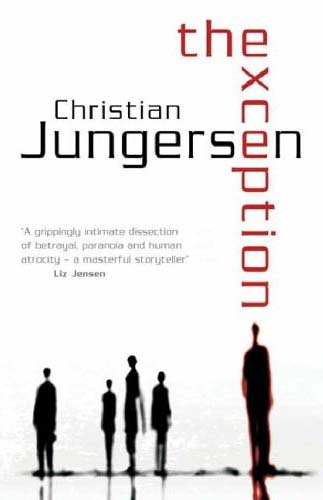
The Exception by Christian Jungersen

After reading the final Harry Potter I was worried about what to read next. What could I get equally absorbed in? I'm off work until Wednesday and so not having to worry about what will fit in my rucksack I chose 'The Exception' by Christian Jungersen, which was shortlisted for the 2006 International Dagger. I have the hardback and the size and weight of it has been putting me off but I'm now quite a way into it and finding it fascinating.

The US edition came out on 10 July and is part of Amazon.com's Significant Seven


Synopsis:
A bestseller throughout Europe, THE EXCEPTION is a gripping dissection of the nature of evil and of the paranoia and obsessions that drive ordinary people to commit unthinkable acts. Four women work together for a small nonprofit in Copenhagen that disseminates information on genocide. When two of them receive death threats, they immediately believe that they are being stalked by Mirko Zigic, a Serbian torturer and war criminal, whom they have recently profiled in their articles. As the tensions mount among the women, their suspicions turn away from Zigic and toward each other. The threats increase and soon the office becomes a battlefield in which each of the women’s move is suspect. Their obsession turns into a witch hunt as they resort to bullying and victimization. Yet these are people who daily analyze cases of appalling cruelty on a worldwide scale, and who are intimate with the psychology of evil. The cruelty which the women have described from a safe distance is now revealed in their own world. They discover that none of them is exactly the person she seems to be. And then they learn that Interpol has traced Mirko Zigic to Denmark.

You can read an excerpt on the amazon product page.

The more portable (UK) paperback came out in June.

Saturday, August 26, 2006

News Update to Euro Crime Website & Christian Jungersen

I've added a few links for recent newspaper reviews and articles to the 'news' section of the Euro Crime Website.

The book getting favourable attention this week is 'The Exception' by Danish author, Christian Jungersen.

Four women work at the Danish Centre for Genocide Studies. When two of them start receiving death threats, they suspect they are being stalked by Mirko Zigic, a Bosnian torturer and war criminal. But perhaps he is not the person behind the threats - it could be someone in their very midst. Much of the drama created revolves not only around the scary sense of a killer prowling in the shadows but also around the manipulative games being played between the women in the office as they come under pressure and turn on each other. The irony is that these betrayals and persecutions are taking place amongst professionals who daily analyse cases of appalling cruelty. Now and again, the narrative is broken with extracts from 'articles' dealing with crimes against humanity and the pyschology of evil. Whilst the women apply this to their work with genocide (and the killer), there are parallels to their own behaviour. It's a fabulous pacy read - a real page-turner that resonates with deeper questions. (from amazon.co.uk)

Susanna Yager reviewed it in The Telegraph calling it ..."a powerful yet disquieting study of the psychology of evil, and a tense thriller" and the Independent describes it as "a horribly vivid and fiendishly clever novel".