Showing posts with label Harrogate 2012. Show all posts

Thursday, September 06, 2012

Front Row Does Harrogate 2012

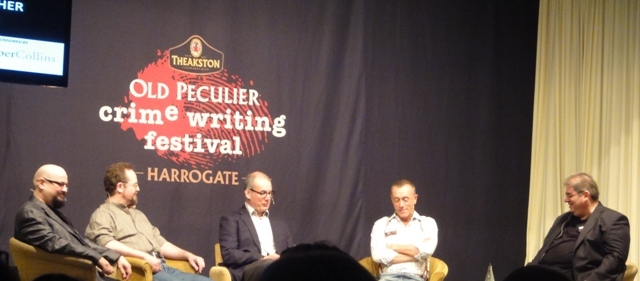
I'm a bit behind the times with these. Radio 4's Front Row have issued two podcasts recently about the last Harrogate Crime Writing Festival including an edited down reproduction of the infamous ebooks panel. You can hear Stephen Leather's comments but not all of the audience reaction. (The original session was an hour.)
E-book debate special 29 AUG 12

Thu, 30 Aug 12

Duration:
29 mins

Mark Lawson chairs a debate on whether e-books and digital distribution represent a terminal threat or a new chance for authors, traditional publishers, agents and bookshops, in a session recorded at the Crime Writing Festival in Harrogate.

plus this one which I've not listened to yet:

Harrogate Crime Writing Festival Special 24 AUG 2012

Fri, 24 Aug 12

Duration:
29 mins

Mark Lawson reports from the annual Crime Writing Festival in Harrogate, with guests including Harlan Coben, Ann Cleeves and John Connolly.

Listen or download both podcasts from the Front Row website.

Wednesday, July 25, 2012

My final words on Harrogate 2012

I've finished writing up all the panels I went to at the Harrogate Crime Writing Festival 2012. You can read these here. I've added photos to the earlier posts including the Crime Novel of the Year ceremony (and a photo of Colin Dexter).

The programming chair (for 2013) returns to Val McDermid who did the first few years. Already announced are: Kate Atkinson, Charlaine Harris, Susan Hill and Ruth Rendell interviewed by Jeanette Winterson.

Hopefully half the authors invited will be women rather than just under a third as in 2012.

The dates for 2013 are 18-21 July.

(In case you're eager to know about the quiz - I joined the Crimesquad team (Agatha Christie's Pearl Necklace team name) and we came second by one point.)

Harrogate - Jo Nesbo

And the final event of the weekend was the interview of Jo Nesbo. The queue was enormous and stretched all through the hotel.

The Harry Hole books in the correct order.

From the programme
Unarguably the star of the current Scandinavian crime scene, Norwegian Jo Nesbo has become one of the best-selling crime writers in the world, with two of his books selling every minute. This success can only increase with the latest Harry Hole thriller, Phantom and Martin Scorcese set to direct a film adaptation of his earlier bestseller The Snowman. There could be no better way to round off this year’s festival than with rock star and crime writing phenomenon Nesbo, in conversation with BBC Radio 4 Front Row’s Mark Lawson.


My notes:
JN wasn't going to come to Harrogate as in Italy but Mark Billingham forced him. He is able to write in airports, on planes and trains. Often pleased when planes delayed! He can write almost anywhere. Bought an apartment to write in and it is the one place he can't. He just needs coffee and music and he's ok.

Jo Nesbo pronounced (I think) Yo Nesboo.

He wasn't full of beans when he found out that Jo was thought to be a girl's name, Jo's not man's name.

He then told a story of when he was in Manilla and saw his books on the shelf in a bookshop. He offered to sign them but shop assistant very suspicious and asked for id. When buying some books, she said I'm sorry without your id we cannot give you writers' discount!

Harry Hole name is based on the police officer in the his village where his grandmother lived. He never saw Hole but grandmother would say Hole would get you if you don't go to bed. He met Hole many years later at a funeral and when chap said he was Hole, JN's first thought - but it isn't 8pm yet.

JN's father grew up in NY and called him Jo not Yo.

[discussion about out of order publication of his books in English] - chaos, randomly published (by Random House!)

Gets a number of emails from people saying they won't read them until get them all in order - sales will take off!!

The first book, The Bat (The Batman) is set in Australia. Wasn't a conscious decision and no idea it would get published. Saw friends trying to write literary novels and failing so decided to write something simple as first novel. Used to writing lyrics and short stories and as he was going to Australia for 5 weeks came up with crime story. Arrived jet lagged and went to hotel (where HH also stays!) and started writing. After 5 weeks had first draft of novel finished. He wrote it so quickly he told publishing house it took a year and a half to write.

HH just came out on page. Planned to send it to publishing house and get polite refusal and keep on writing. Didn't plan as a series. Second novel took long time to think how to include Harry as he wasn't a fully developed character until The Redbreast. Then he knew who he was and found sides to his character. The Batman based on aboriginal myth, half man half bat, ancient symbol of the devil.

Used many clichés of hard boiled detective with contradictions in character - single but romantic, inspired by Frank Miller/Sin City which embraced cliches. Wanted to get to who he was.

[Book two] The Cockroaches set in Bangkok was inspired by Ray Bradbury short stories. Inspired to have readers travel to places never been ie not London, NYC.

Didn't sell rights of first two as strange enough to have Norwegian detective let alone one working in Sydney.

Optimism going forward vs pessimism of WW2. When he was 15 he found out his Mum's family worked for resistance and father fought along with Germans. After the war he spent 3 years in jail. How was the wedding?! Incomprehensible that his father wore a German Helmet, the symbol of evil. Became close to father after speaking to him about it. Father raised in US, came back anti-communist. He said that prison was fair for being as wrong as he was. The Redbreast is his father's story - injured went to Austria, trenches stories from dad. Dad's friends shot in room whilst he slept. There are Norwegians descended from Nazi's breeding programme.

Norway is a young country. After WW2 wanted to say that they had a strong resistance but probably didn't.

[talking about the Utoya/Oslo tragedy] Norwegians do live in paradise but sometimes door opens and something comes in. He was in Oslo on a climbing rope at the time of the explosion and so didn't feel it. Felt weird and then with the news of Utoya it got unreal.

Will there be an impact like 22/7 or 9/11 on fiction?
He had no following so not the same, may be accepted as a tragedy, a natural catastrophe in time.

Trends in his books but are enlarged in fiction eg neo-nazis there since 70s but not a movement that will affect society politically. Norwegians not anti bankers like in Britain (or anti lawyers).

Scorcese film [of The Snowman] will go ahead so long as he stays healthy! There's a first draft of the script he thinks - tries to keep far from it - easy as they don't tell him anything! Dicaprio favourite to star as HH.

ML asks the killer question - you've been writing a HH about one every two years, is that still the case? JN says have you read Phantom? Is is a trick question? Fans will be pleased to hear that there will be another Harry Hole book.

Answers to questions from the audience:

Music has impacted his writing and his generation of writers maybe more than literature. Harry not a big fan of his band though!

All his all favourite writers are dead. What would he ask them? - Why do they write?

How similar is he to HH? Initially no similarities, didn't plan to be him but writing more about self as time goes on. There's a good deal of him in HH.

Latest book is a crime book for children, wasn't important that it was a crime story.

Why do you write? He likes the attention when people come up and say loved your novel. But this wouldn't make you become a writer as the likelihood of it happening is so small. We write because we read.

The end of HH is in his mind but not yet written. No resurrection though.

Phantom is bleak but not as depressing as first chapter of The Devil's Star. Got depressed and had to rewrite chapter a couple of time. Had to take 6 months off after writing TDS, Couldn't face writing Harry. Phantom based on research for The Redeemer.

Headhunters was an enjoyable book to write. Usually plan, write synopsis, but woke up with the idea and wrote it in 2 months.

Jackpot film - based on draft for a story he wrote a few years ago: 4 guys in a room, last working class guys in Oslo! Bet on a football game and win but cannot divide winnings equally as all need it more than others. Each plans to kill the other three!

He has experience with alcoholism amongst friends but can't generalise problem. If you do to much research you end up with general view rather than individual.

Consciously influenced by Sjowall and Wahloo - all writers are even if not aware of it.

Never has an agenda to focus on political issue but cannot write without politics.

[and the last question]

If you could have been a rockstar or a famous crime writer - which would you choose?

[pause]

What do you mean, I am!


Also do read Mrs Peabody's account of the interview.


Tuesday, July 24, 2012

Harrogate - 50 Different Words For Murder

The first of two panels on the final day, the ones I'd been eagerly awaiting:

From the Programme:
With crime fiction from around the world as popular as ever, we ask four overseas authors what, if anything, is lost in translation. Writing originally in Swedish, Spanish and Afrikaans, Camilla Lackberg, Antonio Hill, Deon Meyer and Liza Marklund will tell Barry Forshaw just how much of their work is filtered or coloured by their translator. How much involvement do they have in the translations? And crucially…will we ever get tired of Scandinavian crime fiction?


My notes:
If LM is Godmother of Swedish crime fiction what does that make Maj Sjowall? LM's granny!

BF says that DM is the best crime writer in Afrikaans. DM said that it was a huge honour to be here, thank you Theaksons.

CL's latest book is The Drowning.

AH - poetic title (The Summer of Dead Toys) but kind of creepy, only book so no problem with being translated out of order, set in a very hot Barcelona.

CL is a celebrity for her private life eg being on the Swedish version of Strictly; her personal life was a gossip item 4 years ago complaining about media, got revenge by attacking reality tv in The Stonecutter/The Stranger.

BF asked LM - do we get right image of Scandinavia from her books? Scandinavians like to think were the best and that the problem with the rest of the world was that they are not Scandinavian. LM wanted to covered issues like abused women/children so wrote crime novels about these issues.

BF says Afrikaans has 87 years left. That's enough for DM! DM's English not as impeccable as his Afrikaans mother tongue, which is a beautiful and varied language.

BF: Translators so grateful to be included in Death in a Cold Climate. CL's books are shared between husband and wife team Steven T Murray and Tiina Nunnally. She's never got into how they do that! They are good at emailing her. She rarely hears from translators.

AH has been a translator so knows process.

LM works closely with (translator) Neil Smith, rework US edition quite a lot.

Translators object to editors changing US to British English (or vice-versa) as it's a whole way of thinking not just the language. DM: British people know more about South Africa than Americans as they only know America. DM's US editions have extra paragraphs or chapters to explain.

AH Read English translation (by Laura McGoughlin) and dialogue was very good, she got the rhythm.

CL & LM are huge in Germany, pictures everywhere. CL wearing angel wings! It's really easy to persuade her to get into angel wings! Been a ghost, dead floating body - crazy campaigns for her books.

LM read everything - raised close to Arctic circle (so not much to do) read Enid Blyton, Agatha Christie, Maj Sjowall.

DM sees self as ambassador for SA and try to rectify misconceptions about SA. "Once a time you couldn't have a sympathetic white cop" changed after apartheid.

LM - you never find crime novels in dictatorships.

CL likes contrast between everyday life (everyday dramas) and dead bodies, hideous murders.

Legacy of Franco hangs heavy. AH not so young (he says0 lived under it for 9 years.

The panel hoped they were translated due to quality of book not ease with which name can be pronounced in English.

AH was asked to change his name in Germany as not Spanish enough - add an extra letter - but he refused.

Translators clean up LM in German editions. make Annika more polite. Usually you spend several hours for your author portrait - look nice and then German publisher says we need ugly pictures - want author to look like girl next door, roots showing. DM doesn't have this problem and wife think he looks like Brad Pitt anyway!

Annika is an incarnation of LM that makes every mistake but gets away with it. Women are human beings even if not treated like that. LM likes to be a bit Annika if pushed around. We should all be a bit Annika.

CL: didn't want Erica to be her but writes better about her when she writes about her own experiences. Over time Erica is 50% her. Patrik is based on her ex-husband who was a tax economist but she is now married to policeman.

AH's main character is a melancholic, normal guy unless he gets angry! He beats 1 man up but he deserved it and he is the big brother he would like to have.

BF asked DM which of your characters do you like best? He tries to make them different - question is like being asked to choose your favourite child!. He misses them, as characters become like  friends/family and worries about them and make stories up about what they're doing.

LM wrote about union leaders going to strip club as don't have many scandals in Sweden so have to treasure them.

The Ice Princess started with that image of woman in frozen bath. Got title and story built from that image.

AH had an image of girl in swimming pool surrounded by broken toys - made up whole story to explain this image.

DM - press us very free in SA. Took a while to get used to. Dangerous to write a crime novel trying to make a political point as you may lose readers.

LM writes political novels.

CL doesn't think highly of British press - glad that Swedish press isn't as curious. Tabloids are generally nicer than the UK ones.

DM - some of UK press is the best in the world, some is worst.

AH - journalist write scandals about each other in Spain.

BF asked about sex scenes...

LM tries to write them from a male pov.

CL can't make herself write sex scenes as picture of mum & mother-in-law in her head.

DM - Afrikaans of Cape Flats very specific way of speaking but cannot translate (very musical).

CL - get many questions on Scandinavian crime - analyse the success and why they're so good at it; why do people like reading about Scandinavian countries?

Assassinations (Palme & Lind) were a wake up call pulled them into rest of world. Sweden has problems like any other country, not all tall and blonde. A Kennedy moment when Olaf Palme killed. LM said Sweden was 50 years ahead in 1950s as weren't in wars.

Why are Latin countries not as popular. Climate? AH - show we can kill, don't need snow. Not a long tradition of crime fiction in Spain most papers won't review crime fiction.

Corruption endemic theme in all books. No worse in SA than UK, UK politicians "cook the books" (DM). CL said Swedish politicians aren't as colourful or don't hear about it. Now economic scandals as sexual scandals are not scandals any more!

Literary reviewers think CLs books are written in too everyday language and so put their success abroad down to really good translators. LM said Scandi books not better but have a spotlight on a whiter society and spots are darker;the contrast is bigger in Scandi society.

CL - people are curious about Sweden.

LM in Germany always gets question - why did you start with 4th book - only gets that in Germany!! (could be out of order translation or down to the fact that her first book The Bomber is a later one chronologically)

CL in Italy - got so many questions abut Patrik staying at home looking after baby. Convinced a large audience of women that it was a good idea.

DM - email feedback is about the books but when on tour is asked abut country.

AH get different questions about woman character, depending on country - too sexually liberated for some.

DM - 85% of crime is domestic and drug/alcohol related.

LZ - theme is power, in all novels, and stories around that.

DM - vast majority of crime is in disadvantaged communities.

Question from audience about British authors writing about their countries eg Spain (Quintin Jardine) and Alexander McCall Smith (Africa):

AH says why not, have a different view.

CL says "stay away!" (re Brit writers writing about Scandinavia)

DM says that AMS gets Botswana people exactly right, No crime fiction novel can be a panoramic view of all society. Thinks AMS absolutely brilliant and does it very very well.

Comment from German member of the audience post-war Germany very stable, crime fiction very pop since 50s. Patricia Highsmith not seen as crime writer in Germany or Spain.

Ruth Rendell often mentioned as being read by Scandinavians. CL a crime nerd since little. 80% of her reading is crime.

BF ended the session by saying the Germans are coming...


Monday, July 23, 2012

Harrogate - Deadlier than the Male

One of the things I did notice at the festival is that despite the reported figure that 80% of crime readers are women which was also borne out by the audience demographic, less than 33% of the authors appearing were women...

From the programme:
Is it women who write the most graphically violent crime fiction? Or has this simply become a myth that should be nailed once and for all? And whether written by men or women, why is it that the majority of this fiction is bought by female readers? Journalist Danuta Kean puts some uncomfortable questions to Jilliane Hoffman, Julia Crouch, Amanda Kyle Williams and Tania Carver aka Martin Waites who (as a man writing as a woman) has a stiletto in both camps.


My notes:
80% readers of crime fiction are women

Are women deadlier than than male?.

MW: There is a perception - he thinks he writes the same level of violence as Martin or Tania. If involved violence should hurt, not keen on graphic violence. Perceived as a blokey writer as Martin - that's because he's a bloke!

AKW: don't think we're more violent, there's a bias as people don't look for females when there is a serial killer on the loose. More shocking for women to write violence but they also have ability to write from victim's perspective.

JC: more in touch with fear; men are more likely to be attacked but they don't feel scared.

JH: rape - women can imagine it. Scene in Retribution doesn't say what attack involved. Women have more imagination than men and  they can imagine what happened. Mustn't cross line and go grotesque.

Why do women read so much crime fiction?

We're drawn to what makes people tick.

MW: men want to find out what people tick too.

JH: has the female come in and save the day. The Cutting Room sees return of CJ Townsend. JH's heroine kills the dragon.

AKW - her heroine kicks ass. Makes no apologies for the fact that it's violent. Readers read crime fiction as drawn to the dark.

JH - impart to readers what it feels to be a victim. We're desensitised to word rape so have to take reader through that night - readers wouldn't understand victim until they understood the crime; what motivates her to prosecute someone who may or may not be guilty and put them on death row.

MW - The Surrogate based on real life case in USA. who would do that? He got his wife Linda involved as of the two she's been more pregnant... Not gratuitous, did it like (film) Se7en and doesn't show much. Would have been different perspective if it was a Joe Donovan book. The last book his wife said read like a MW book so had to scrap it and rewrite as TC.

JH - The Cutting Room features a snuff group - fairly sure that one exists.

AKW - Scaring you is my job and I enjoy it.

MW - The White Room, one of two novels wanted to write as grew up few streets from Mary Bell (child killer) - it was a real miseryfest to write (though Guardian book of the year). He was writer in residence at a prison and one when he was in lockdown wrote male rape scene - later reread it and wondered where it had come from.

AKW - respects readers - entertainment and that's kind of it. Story reads fast and reader is satisfied in the end. Doesn't take self too seriously.

JH - check all is accurate, legally, medically.

JH - "know enough to fake it good"

AKW - would never harm an animal

JC - A French review of Cuckoo said don't harm the children; wouldn't do it in much detail

JH - no harm to children or animals, had to bump up age in Pretty Little Things (child pornography).

Harrogate - New Blood

And on to the next panel. Val McDermid's very popular "New Blood". As you can see the room is huge and I was so far back I had to watch the tv screen and couldn't take any useful photos.


From the Programme:
Always a festival ‘must see’. Queen of Crime Val McDermid has hand-picked four of the hottest new talents on the scene and invited them to discuss their debut novels. Eager readers on the lookout for the next big thing will be spoiled for choice as Val introduces Elizabeth Haynes (Into The Darkest Corner), David Mark (The Dark Winter), Oliver Harris (The Hollow Man) and Kate Rhodes (Crossbones Yard).

My notes:
VM gets sent piles of debut books so she can pick authors for the panel. Keeps her up to date as well as getting a list for hitman. Crime fiction has expanded over the years, you can go anywhere do anything. Buy & Try!

All here because VM loved characters and voices.

OH - police procedural very unlike Dixon of Dock Green

LH - took pole-dancing clasees for research.

DM - a man of mystery! The Dark Winter is set in "joyous sea side town of Hull" as fun as you'd might expect...

KR is a poet

[then followed an intro to all the books - links to reviews are above.]

LH - the OCD plot was device for word count (as written for NaNoWriMo) and think of what to do next. VM used to send Kate Brannigan to the supermarket for similar reasons.

DM - born in Carlisle.

OH - write to explore other aspects of people's lives, experimental form to take apart what's going on.

LH - worked for police intelligence - wrote romance in playground, 50 shades of jelly baby (VM). Massive crime fiction fan but could never find any justification for crime, so was part of reason she applied for police job, to inspire her fiction.

Boundary between crime fact and fiction. Darkness in book. VM can read violence but terribly squeamish.

DM - write about what you know. As a journalist for 7 years has met many victims of crime (crime reporter). Natural affinity. Lucky to get job at 17, almost immediately attending murder trial.

KR fed up with poetry after 15 years, very lonely. Like to have a conversation with readers, loved crime fiction, very classy and very good at the moment especially in Britain.

VM - you have to care about a character whether you like or hate them.

VM - George Bennett in A Place of Execution was given self-doubt as a result of It's a Wonderful Life.

DM's main character is very earnest, good - which is tiresome and he has arguments with him in his head. VM says What drives McAvoy is his love for wife and child

KR's next book is about bankers dying (big cheer from the audience).

Harrogate - The Golden Age?

My next panel was on Saturday morning about The (A?) Golden Age.

From the programme:

For many, the Golden Age of British crime fiction was the 1920s and 1930s, when writers such as Christie, Allingham, and Sayers were at their peaks. Others would argue that we are currently living through crime fiction’s true Golden Age and that contemporary writers are more than a match for the Golden Oldies. Banging the drum for the here and now are Stuart Neville and Robert Wilson, while Nicola Upson and David Roberts will be talking up the cosies. Chairman, Martyn Waites (aka Tania Carver) will do his best not to take sides.


My notes:
The Golden Age dead or is it now? Was it the Golden Age and what made it so?

NU crucial age of crime fiction was between wars as lots of writers working with set conventions. TGA established a genre of crime fiction with set rules that can then be broken.

DR hates that word cosy - demeaning and patronising. TGA started 1920 and died out in 1950s; there were some superb novelists eg Dorothy L Sayers, who despised own books; Agatha Christie was a good writer, Tey, Nicholas Blake - that's what makes it GA - very good writers and better than a lot today (ooh! -  controversy)

RW said after WW1, needing to set the world to rights. He reminded self of GA by reading Strong Poison (DLS); ruling classes wiped out the working class by bad decisions, but business as usual in novels. DR disagreed - upper classes suffered great losses too, first over the top life expectancy of two weeks for young officers. Rules about good and evil, which are not so clear in modern novels as "evil" is explained by social reasons. RW said that by the end of WW2 knew what is evil is : Hitler.

NU: direct correlation between WW! and GA but not due to class. Books show the importance of an individual life -  one life can matter against mass slaughter of war.

SN asks who's reading GA?

MW:  Christie villains often a foreigner or a member of working class. But DR said don't forget Poirot ia foreign refugee and that Miss Marple is part of a despised generation and a spinster. Upper classes can ask questions and and travel so as not restricted to a couple of villages like Midsommer Murders - so convenient  to have aristocratic sleuth, not just snobbery.

Character of today's crime fiction.

SN said not *the* GA,  several GAs eg Chandler, Hammet, Irish (though not sure that's true), Scandinavian.
 
SN writes about a sympathetic mass murderer. Sophisticated readership needed?

DR said there was too much violence in RWs books. The constant use of violence is like a drug, keeps needing to be increased.

MW said have moral responsibility to put violence in book as dealing with a violent death.

NU:  Tey made a distinction between legal and moral justice.

DR:  Harret Vane (in DLS) almost died,  not because of murder but because of not being married to the person she was living with.

MW: when read GA didn't recognise the England in it as he grew up in Newcastle.

Is it yearning for an England that didn't exist?

SN - all crime fiction is escapism. Amplified compared to real life and you get justice - also rare in real life.
RW - Scandinavian crime fiction popular as seen as ideal countries, now no-one want to go there!

MW - original titles of TGWTDT - Men who Hate Women - could be a title for any noir novel.

NU - Not all GA set in village eg Tiger in the Smoke by Allingham is set in London. Read Tey to see what it's like for women between the wars.

DR - why would you reread once you know the killer but AC still read in France, USA. How many books written today would people go back to? No cohesive school.

SN - there are movements rather than individual novels: tartan noir, Irish, Scandinavian.

GA definition excludes writers such as Patrick Hamilton.

Books read from that period do seem to be crime fiction rather than best sellers/classics (eg Huxley)

MW - nice if bit sooner didn't have to wait 50 years to be feted.

RW is term cosy patronising? Yes says DR.

AC is fondly remembered as bridge gap between child and adult reading.

MW suggests that cosy has mutated into forensic novel? eg Patricia Cornwell doesn't look at psychology behind it, less cake and more blood.

NU: best novels put character forefront.

DR would put P D James into GA. He hates violence and serial killers in modern stuff. Detective who is alcoholic, chip on shoulder and close family is investigated and they go and investigate - "word for it, self-indulgent comes to mind".

MW mentions Knox's The Decalogue, the ten rules for crime fiction reads out many of them eg must not include a Chinaman.

SN love writing from villain(s) pov, if couldn't write from that then couldn't write at all.

DR asks do you identify with killer? SN says evil doesn't know its own reflection. In their mind are doing the right thing. NU loves to write murder's pov as well. People like you and me not evil. Doesn't see self as writing GA novels as writing with modern sensibility re sex, violence set in the past. MW every one is a hero in their own story.

DR greatest proponent of this is Patricia Highsmith with Ripley - a modern GA writer, little violence but MW disagrees. There is violence but not modern torture.

RW re Thomas Harris - M Mann version of Lecter was evil, Anthony Hopkins version is a vaudeville character but more popular.

What have we gained/lost from GA?

SN it established a framework. Variety crime fiction can take. (leading onto phrase) transcends the genre - MW "twatish phrase that is!"

NU books we can enjoy, in bucket-loads. People return to Tey

DR more than just taking a sweetie - put aside Henry James and pick up Aggie with a guilty sigh.

Question from the audience:
Why do people keep creating defective humans?

MW - people like to read about damaged people and so feel better about self.

SN - deals with phsical rather than emotional damage in new book.

MW - happy is hard to write about. SN - Brian McGilloway does it well

DR - write about decent people not necessarily happy

NU  - most damaged person she's written about- Alfred Hitchcock. Day to day morality for Tey and DLS - they didn't always write abut murder

SH - defective detective - can work if genius eg Sherlock Holmes.

DR - loves P James books but wishes Grace would "only find his bloody wife" and then he could relax.

MW: any good novel should make you laugh/cry/think.

First GA was female, English writers and second one influenced by Americans.

Chandler and Wodehouse in same class at Dulwich. Imagine Marlowe & Wooster together!

Sunday, July 22, 2012

Harrogate - America's Got Talent

This is the last panel I went to on Friday, America's Got Talent. I've almost finished reading Gillian Flynn's compulsive Gone Girl and I have one of Megan Abbott's books in my tbr. And with John Connolly moderating you know you're in for a well-researched and witty time! This was a very good panel and spurred many a purchase.

From the programme:

We are thrilled to showcase four of the most acclaimed new crime writers in America. Ryan David Jahn’s Acts Of Violence won the New Blood Dagger while Sharp Objects by Gillian Flynn picked up not only the New Blood award but also the Ian Fleming Steel Dagger. Chris Mooney has received rave reviews from the likes of Michael Connelly and Dennis Lehane and Megan Abbott’s hugely praised The End Of Everything was a Richard and Judy Book Club pick. These four will be talking to one of this year’s special guests, John Connolly.


My notes:
JC opens by saying that his panelists are "linked by a common inability to pronounce aluminium. It's alu-min-ium."

It's soon apparent that Chris Mooney is the fall-guy for JC's jokes. JC makes several references to CM's Remembering Sarah which was Edgar-award nominated.

GF's first book Sharp Objects was described as having a moist tone and JC wanted to know what that was exactly! GF described it as a lush, sensual, Gothic tone.

(Incidentally Gillian is pronounced with hard G.) She writes for Entertainment Weekly Magazine, full of pop culture and writing gives her the opportunity to be the opposite so you won't find any pop culture references in Sharp Objects. Gone Girl is borderline crime fiction and very different to her first two books; she wanted to write about relationships and marriage, and then had to construct a mystery around it. Bleak look at married life.

In MA's Dare Me - the crime is almost incidental, not jacketed here as crime novel. MA was editor of school paper; cheerleaders remind her of soldiers, very athletic training nowadays.

CM moved Malcolm Fletcher from peripheral character n an earlier book to main character in new series.

His Darby books came easier, writing about women, wants to understand women.

Question from JC about the practice of putting people's ashes into strange things ("you Americans") and there is a company in the US putting ashes into bullets.

RDJ - screenwriter before but didn't like producers much, as they made changes based on structure rather than story based. He worked in reality tv and was fired. The Getaway/Thompson influence on The Dispatcher. Fascinated by violence as experienced in the moment not war as a subject.(He was in army)

MA is a movie lover, and gangster movies were always on when growing up.

GF's dad is a film professor so she saw Alien at age 7!

MA said that in the US, they are very influenced by the idea of lone man, outlaw and 50-75% are about a PI or a cop who is against the system.

(JC did ask which British writers they read: Mark Billingham's name came up but the panel didn't give the impression of reading many British authors.)

JC said he didn't moderate many panels as it was too much like homework but he thoroughly recommended these four authors.

Saturday, July 21, 2012

Harrogate - Writing for Your Life

I missed the controversial e-book panel to get some sustenance and returned for:

Writing for Your Life:

Writers are often told to ‘write what you know’, but what if that knowledge could cost you your life? This is a unique opportunity to hear former intelligence agents and investigative journalists talk about revealing the secrets that some people want kept hidden. From the safety of their cosy offices, most crime writers routinely knock off tales of murder, but David Hosp, Chris Morgan Jones, Tony Thompson and Boris Starling tell Charles Cumming what it’s like when the writing itself is a matter of life and death?


My rather brief notes:

CC applied to work at MI6 but contrary to rumour didn't get in. Thinly disguised Vladimir Putin in The Trinity Six.

CMJ: described as a "loss" when lose a target that's under surveillance. Cannot track someone with just one person unlike in films/books.

BS also writing as Daniel Blake with a series set in the US: New Orleans, Pittsburg.

DH writes on ferry to Boston and back cf le Carre on a train

TT is a true crime writer - has he risked his life - yes and told of when he interviewed a criminal called The Governor; he only wanted a short quote and so took no notes. The Governor rambled on for an hour and then wanted TT to read his words back to him. TT had a few minutes to decipher (his non-existent) shorthand notes and then had to read it three times (in front of burly thugs) before being allowed free.
DH (a lawyer) is involved in the Innocence Project - looking at cases where the person might be innocent. His third book, Innocence is based on the project - a real case where fingerprint faked and whole dept shut down for 3 years,

CMJ would get others people to take risks, didn't do surveillance himself and recommends that you always have a woman on the team as they are less obtrusive.

DH's new book, The Guardian, is a standalone looking at the changing role of women in military, though they can't go into combat there are a lot in military police. he's toying with the idea of bringing her back.

Harrogate - Drawing the Line

My third panel and this time I took notes by hand. Drawing the Line featured Tim Weaver, Margie Orford, Penny Hancock, Gregg Hurwitz and N J Cooper moderating.

Panel blurb: When it comes to making moral choices, how far should a writer go? Do they worry about titillating those who may be tempted to emulate the terrible crimes they read about? And do writers ever fear for their own psyches when coming up with ideas which push the envelope of acceptability?


My notes:
NC commented that kidnap featured in novels by all 4 of them.

MO said that South Africa is much more dangerous than England, children, people do disappear. [I'm not sure if she was joking] said that she had morgue on speed dial as she has 3 daughters. South Africa is rape capital of the world. It's more fun to write emotional torture than physical.

GH said that he would sometimes leave an important bit out of a description eg if he was describing making a bomb.

MO came to write crime to try and understand why there is so much violence in South Africa.

PH wanted to explore the psychology of a woman (who'd kidnap a teenage boy) - wouldn't be interested in the scenario if the genders were reversed. Hasn't found any examples of a female kidnapping a boy.

TW said that 25% readers found his first book too violent and said he was hurt by that as it it implied that he had no control over his writing. There was going to be a scene with dog cruelty but he was advised (and did) to take it out.

MO was going to have the cat killed off - as didn't fit her character's life but she received an email from a fan saying whatever you do don't harm the cat. The cat was reprieved and she has to re-edit book and put cat care routines in!

MO - fear of fear, moved back to South Africa in 2001 with her 3 daughters and was scared but the mortuary on a Monday morning would show bodies of young men, not women. Said that dead women are often passed to women pathologists as men get too upset. Superstition that if you write about something you are warding it off.

Both GH and MO are reported to be more pleasant when working on a book.


There is a poison line you can ring in US and GH rang to ask about the poisonous nature of oleander and there was a pause and the recipient of the call asked "Sir, may I ask what number you're calling from"!

MO wrote journalist pieces but needed more space to explore true crime. Cops - fluke if they catch someone - only chiefs of police going to jail at the moment. Most people in South Africa experience violence themselves or a close family/friend has.

Harrogate - Crime in Another Dimension

The second panel of the day at Harrogate was Crime in Another Dimension. Talking cross-over novels were Ben Aaronovitch, (Euro Crime favourite) Christopher Fowler, Stuart MacBride and Charles Stross, moderated by David Quantick.

This was a chatty and funny panel with a running joke about changing your name by adding a letter or calling yourself  S J.


Here are my notes:
BA writes cross-overs due to laziness as he couldn't decide what genre to write so put it all in one novel. He's not sure if it is easier, but you have to write what you enjoy writing. Writers' ego believes that people will want to read what you've written.

CF start where you are most interested, Bryant & May contain supernatural but against the mythic background that is London. 2000 years of history. Asked why B & M not aging properly - because they're like the Simpsons, it's fiction! Addresses issue in new book (Bryant and May and the Invisible Code) though Bryant avoids answering.

BA made his hero 25 deliberately to avoid the Rankin problem (retirement age).

SM calls Halfhead a near future thriller not SF. He wrote it before the Logan books and would like to do something different but publishers not keen.

CS Rule 34 , set 15 years ahead. 90% of near future is here today. 9% is new stuff 1% unimaginable. As part of research he discovered that anything you can imagine - there's pornography about it.

David Tennant  was to narrate Cold Granite but got cast as Dr Who so didn't. (Some discussion about Michael Moorcock's Dr Who book - The Coming of the Terraphiles - apparently he didn't want to do it but they kept throwing money at him) SM available for Dr Who book project as loves Dr Who.

BA - book was originally a tv project, cliches bolted together, originally level entry role for a Jamaican woman but then wrote the name Peter Brant and background developed. You can pay police for info (300 pounds) and speak to a currently serving officer rather than a retired one.

CF - a bitter WPC sent him her notebooks, which seem to be in code with all the police acronyms!

CS - suggests looking for blogs of serving cops.

( I think BA said this) Wallander has no reason to be depressed, 1 murder every few years he should just be pleased when there's a murder!

Audience question:

Which book of their would the authors recommended you try

CS: The Atrocity Archives
SM: Currently unpublished novella, Ring of Githa (from sound of it won't get pubbed!)
CF: Kalabash
BA: Rivers of London

Friday, July 20, 2012

Harrogate - John Connolly interview

So, I'm currently away at the Harrogate Crime Writing Festival. There are loads of people some 12000 tickets have been sold.

The events are in the ballroom at the Old Swan Hotel. Unfortunately for those of us taking notes, the lights are dimmed and there aren't any power sockets. Hence my notes are written in the dark!

Here are my notes from the first session, Mark Billingham interviewing John Connolly:

It took JC about 5 years to write Every Dead Thing (he admits to not being a very good journalist)

He was awarded a huge advance for EDT but at the time had an empty bank account and needed an overdraft to buy a car. When he came to borrow money, bank knew who he was and didn't ask him to sign any papers (one rule for one and one for little people; he was no longer little people)

Being a freelance journalist meant you are responsible for your own destiny.  As a writer you live in perpetual fear of being dropped despite him having published 11+ books. Reality is that you can be dropped you only have 2 book cushion. Writing a series limits experimentation. With most writers' standalones you could drop main character in; there's no real broadening of range. Readers may not follow you to you new book as follow characters; very few parts of literature where you can dip into lives of characters from book to book.

JC a late bloomer reading crime fiction. James Lee Burke - arguably the greatest living crime writer in terms of language and landscape ("you can argue but you'd be wrong") and Ross MacDonald (being republished by Penguin) whose empathetic character is like a christ figure taking on everyone's sins.

No tradition in Irish crime writing and he didn't want to start one. Grim in 1970s, didn't want to write about famine, Irish writers didn't engage with England, wouldn't model themselves on English writers. Difficult to write crime fiction whilst mired in the Troubles, all criminality linked to IRA so couldn't write about crime without writing about Troubles.

Benjamin Black couldn't couldn't have written Christine Falls at the time it was (1950s) set as it was about Magdalen Laundries.

Irish authors get a better response in US and sell better.

He didn't expect to be published, rejected by everyone except current publisher and agent. Given wise advice to finish writing for own reasons ie if left unfinished he may not have written anything else.

Doubt is what makes it good if you think 20k words in its rubbish then probably worth reading in the end.

It wasn't until the third book that he thought he was going to be writing for a while and the books change and become a sequence of novels (The Unquiet almost a standalone). Writer's first book is an index of what writer is going to write about in his career.  Each book is an experiment, different pacing and tone. Very little violence in The Burning Soul and more dialogue.

He has to find something for Louis and Angel (two popular characters) to do without it seeming gratuitous - they change the tone - add humour and humanises Parker - so you can see why people like him. Also to help reader through book, and a reward for long descriptive passages.

MB said books described as supernatural thriller or detective gothic (or shit says JC)

JC read horror as teenager - good way for teenagers to engage with adult world, why Twilight so popular. Adults shouldn't be reading it. Just stop and read some Dickens.

When he first came to Britain - he saw how conservative British crime fiction establishment was.

Going on to talk about Noctures (a collection of ghost stories): radio very big in Ireland so when asked if he wanted to write for tv said would do ghost stories for radio -  supposed to be for late at night but first series went out at 4pm!

The 'good daughter' short story in Nocturnes made into film with Kevin Costner. JC is very protective of books but filming a short story is expansion rather than compression. It's a fairy tale but it was moved to South Carolina which has no tradition of fairy tales. He says film is not bad but a bit slow.

The Book of Lost Things made MB cry slightly - partly autobiographical

One of his villains is back in The Wrath of Angels.

People aren't evil but are selfish

The Inkpot Monkey was the first short story he wrote.

Charlie Parker has JC's sense of humour but also glass is half empty/introspection.

The favourite death scene is written is for a man who was using a mobile hone in a cafe and was beaten and then shot - based closely on an incident JC had experienced (ie the phone, not the killing!). It's in Bad Men and the victim is given a lecture on phone etiquette.

JC and Declan Burke have just edited Books to Die For (out August) - 120 crime writers from around the world asked about the single book they'd force on a reader; one of the best essay's is MB's on The Maltese Falcon.

Thursday, July 19, 2012

Winner of Theakstons Crime Novel of the Year Award 2012

The winner of the Theakstons Old Peculier Crime Novel of the Year Award 2012 was announced tonight at the opening ceremony for the tenth Harrogate Crime Writing Festival.

And the winner is...Denise Mina for The End of the Wasp Season

Also Shortlisted (links are to Euro Crime reviews)

Now You See Me by SJ Bolton (Corgi)
Where the Bodies Are Buried by Chris Brookmyre (Abacus)
The Burning Soul by John Connolly (Hodder Paperback)
Black Flowers by Steve Mosby (Orion)
Before I Go To Sleep by SJ Watson (Black Swan)

Photos of (some of) the nominees receiving their tankards:

SJ Bolton

John Connolly

Denise Mina
Steve Mosby
SJ Watson

Colin Dexter speaking after receiving the Theakstons Old Peculier Outstanding Contribution to Crime Fiction Award:


and the winner of the crime novel of the year is...Denise Mina (with Simon Theakston)